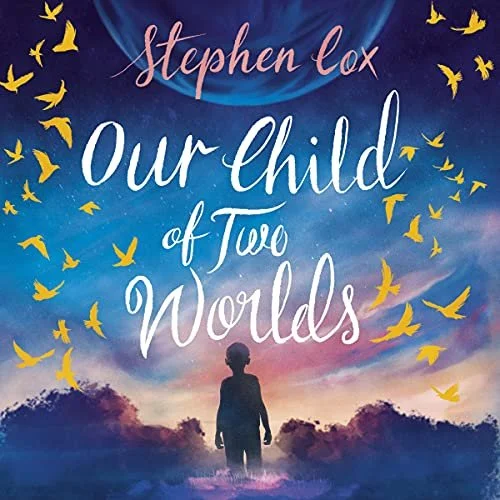
Our Child of Two Worlds
“All happy families are alike, but every unhappy family is unhappy in its own way.” Leo Tolstoy wrote those words in Anna Karenina, but Stephen Cox’s new book, Our Child of Two Worlds, offers a counterpoint to this truism. The Myers family at the core of the novel is a happy family, but they are unlike any other family.
This is because the Myers’s adopted son, Cory, is an alien. In the first novel in this series, protagonist Molly Myers secretly adopts Cory after the spaceship his family is on crashes near her small town in New York State, USA, in the 1960s. In the first novel Molly, her husband Gene and a few local allies protect Cory from the government and mobsters who would take him away.
Every family has its struggles, and the Myers are no different. Cox’s previous novel, Our Child of the Stars, showed how a family came together despite their struggles. Cory completes the Myers family. The Myers are not a usual small-town American family, but together they do create a nurturing, caring, loving, mutually reinforcing environment.
The optimism of the 1960s
In this new novel challenges arise to the Myers’s happiness. The Myers family is unhappy in a way that is unfortunately alike many ordinary families, as this second book shows how a family can fall apart. Cory’s non-human family looks likely to return, to take Cory away from Molly and Gene. Also, Molly’s sister Selena seeks shelter with the Myers after she experiences domestic abuse at the hands of her husband. The Myers may be an unusual family, but their troubles are sadly all too normal.
The first book captured the optimism of the 1960s. Rising living standards, new consumer goods and technological advancement - epitomised by the space race - made people optimistic about the possibilities of tomorrow. This is summed up by Gene - who is a bit of a hippy and writes songs in the style of Phil Ochs or Pete Seeger - saying that in the future we will live on the moon in a UN run city of all nations that has no violence or weapons.
This book touches on the darker side of the 60s. The war In Vietnam is a constant background presence, as is the civil strife that gripped the streets of America in the 60s when black people demanded their civil rights and were met with harsh state and private resistance. The fact that the optimism of the space race was not available to everyone is best summed up by Gil Scott-Heron’s song Whitey on the Moon.
It’s easy to be cynical
Cory and his people provide an inspirational alternative to flawed humanity. The purples - as they are called - don’t have war or racism or poverty or destroy their natural environment. Their looming return asks the question: does humanity need some outside force to change us? Can we fix our problems ourselves?
It’s easy to look at the failures of 60s optimism and be cynical. We didn’t end up living on the moon and more people in the “give peace a chance” generation voted for Richard Nixon than left-wind Democrat George McGovern in the 1972 presidential election. They have also bequived to their children a worse natural environment and countries (at least in the West) more divided than at any point in their recent history. Even in the 60s peace, love and man on the moon stood in stark contrast to Charles Manson’s killing spree or the increasingly apparent problems of cocaine and heroin use.
Yes, it’s easy to be cynical - that’s partly why many people are cynical - but there is always cause for hope. Tolstoy had strong moral beliefs and was influenced by Jesus’s instruction to Turn the Other Cheek. This led him to be a pacifist. We can be inspired by Tolstoy to seek more love and less hatred in the world. To achieve this, we need stories that connect us with other people. In this storytelling process, science fiction is a critical genre as it encourages us to think starkly about what we have in common with people who are different to us.
Love and accept people
The Myers find love for Cory despite them not being from the same planet and their mutual love overcomes the obstacles thrown at them. Cory tells us to be accepting of other people despite our differences, it's not Cory, the outsider, the different person, who wants to hate people who are different. Cory doesn’t understand this. He teaches us to love and accept each other.
I’m a sucker for some 60s optimism. I’m with you Gene. I want to live in a city on the moon where everyone is welcome. Despite the darker side of the 60s and the failed dreams, I still believe that we can make the world a better place. So too does Cory. There’s no need to be cynical.
Cory is very different to us, but he also embodies what’s best about humanity. He encourages humanity to rise above the dark side of our nature. This book has a powerful message about love. One we need now more than ever.