The Lion and the Unicorn: Why Orwell’s English Revolution still matters
By someone who has read George Orwell with enough fervour to smell the tobacco on his fingers and the war-dust in his coat.
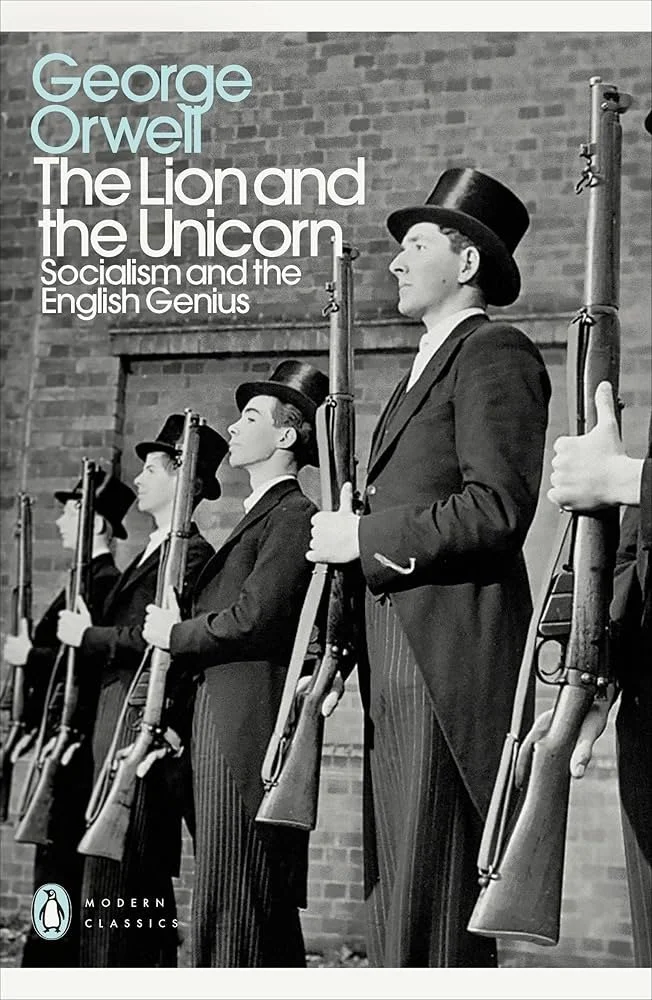
If one wishes to see how deep the rot runs in British politics today, one need not squint through a fog of nostalgia or nationalism. Just take a glance at The Lion and The Unicorn: Socialism and the English Genius, George Orwell’s wartime essay of 1941. It is a strange book; half love letter, half political manifesto, and all very, very English.
Not "Keep Calm and Carry On" England. Not even "God Save the King" England. This is chip-shop, chimney-smoke, fair-play-even-on-the-football-pitch England. Orwell, brilliant curmudgeon that he was, believed this grubby little island was still capable of something radical.
An English revolution
Yes, Orwell called for a revolution. An English one. Which sounds, frankly, absurd. England? The land of queues and tepid reform? Orwell wasn’t calling for the chaos of the French Revolution or a Bolshevik bonanza. In his words the English revolution would abolish the House of Lords but would keep the monarchy, like ordering a vegan sausage roll with a side of blood pudding.
Don’t scoff too quickly. This wasn’t conservatism in disguise. It was radical in a distinctly English way: rooted in the history and traditions of England, but reaching towards the future. Right now, as Britain limps from one political psychodrama to the next - Keir Starmer tiptoeing to the right, the Conservatives openly flirting with fascistic policies, and Reform promising nothing but beetroot faced rage - Orwell’s vision is less of a relic than a warning.
A revolution with a cup of tea
The Lion and the Unicorn opens with a famous invocation of the Second World War: “As I write, highly civilized human beings are flying overhead, trying to kill me.” The book goes on to argue that an English revolution is necessary to win the war and, as such, was inevitable. Orwell describes this revolution with the deft touches of an abstract painter, just enough to get a clear view of the emotional outline of something that is intangible.
Here is how Orwell describes the revolution in The Lion and the Unicorn:
“It will not be doctrinaire, nor even logical. It will abolish the House of Lords, but quite probably will not abolish the Monarchy. It will leave anachronisms and loose ends everywhere, the judge in his ridiculous horsehair wig and the lion and the unicorn on the soldier’s cap-buttons. It will not set up any explicit class dictatorship. It will group itself round the old Labour Party and its mass following will be in the trade unions, but it will draw into it most of the middle class and many of the younger sons of the bourgeoisie. Most of its directing brains will come from the new indeterminate class of skilled workers, technical experts, airmen, scientists, architects and journalists, the people who feel at home in the radio and ferro-concrete age. But it will never lose touch with the tradition of compromise and the belief in a law that is above the State. It will shoot traitors, but it will give them a solemn trial beforehand and occasionally it will acquit them. It will crush any open revolt promptly and cruelly, but it will interfere very little with the spoken and written word. Political parties with different names will still exist, revolutionary sects will still be publishing their newspaper and making as little impression as ever. It will disestablish the Church, but will not persecute religion. It will retain a vague reverence for the Christian moral code, and from time to time will refer to England as ‘a Christian country’. The Catholic Church will war against it, but the Nonconformist sects and the bulk of the Anglican Church will be able to come to terms with it. It will show a power of assimilating the past which will shock foreign observers and sometimes make them doubt whether any revolution has happened.
“But all the same it will have done the essential thing. It will have nationalized industry, scaled down incomes, set up a classless educational system. Its real nature will be apparent from the hatred which the surviving rich men of the world will feel for it. It will aim not at disintegrating the Empire but at turning it into a federation of Socialist states, freed not so much from the British flag as from the money-lender, the dividend-drawer and the wooden-headed British official. Its war strategy will be totally different from that of any property-ruled state, because it will not be afraid of the revolutionary after-effects when any existing régime is brought down. It will not have the smallest scruple about attacking hostile neutrals or stirring up native rebellion in enemy colonies. It will fight in such a way that even if it is beaten its memory will be dangerous to the victor, as the memory of the French Revolution was dangerous to Metternich’s Europe. The dictators will fear it as they could not fear the existing British régime, even if its military strength were ten times what it is.”
Disliking or disagreeing
This is a revolution coming from the trade unions and not the Labour Party, which, to be honest, sounds about right today. However this is a technician and expert led revolution, not a grassroots rising. It’s more of a Marxist-Leninist vanguard revolution, the sort of thing that happened in Russia, than a decentralised socialist-anarchist revolution. I know which one I prefer but maybe I spend too much time online or in anarchist bookshops.
It’s easy as a socialist to dislike or disagree with what Orwell outlines because it’s not good enough. For example, he says that the coming revolution would abolish the House of Lords but keep the King. Personally, I think we can do away with the King as well. Not in an Oliver Cromwell “off with his head” sort of way, but stripping him of public offices and property. He can keep the art and Balmoral, if he pays taxes as a private citizen.
There is also a part about shooting traitors and crushing opposition that makes me very uneasy. This sort of talk was more common in the 1940s but is still frankly terrifying. Orwell did always have that public school/military authoritarian streak in him, despite being one of the best critics of authoritarianism.
Orwell vs vegan hipsters
This is not the type of revolution that Karl Marx wrote about that would break down national boundaries as the world’s workers united against the bosses across nations. Most of today’s socialists wouldn’t support this. Then again Orwell disliked the vegetarian moralisers (today’s vegan left hipsters) and rails against them in The Road to Wigan Pier.
However, what Orwell proposed was radical at the time. Orwell also argued that it was inevitable as it was necessary to win the war and defeat fascism. It didn’t happen and the war was won anyway. However, what he wanted can still inform the left of today.
Socialism you could explain in the pub
What Orwell proposed was a socialism you could explain in a pub without getting punched. A kind of revolutionary patriotism. One led not by theorists in ivory towers, but by technicians, trade unionists, and the occasional grumpy civil servant who actually knows how to run a railway. He wanted the state to take over land, banks, and industry because he believed it was the only way Britain could survive the war and create a more just society.
To Orwell, fascism was something you prevented not just with guns, but with decency. British decency. He believed that fair play was essential to the English character and that was a bulwark against fascism. He argued that the English, yes, even the snobs and colonels, had a stubborn allergy to totalitarianism. It’s why the Blackshirts never really took off, and why, even today, Britain’s fascism wears a blazer, not jackboots.
Let’s not get too comfortable. That allergy is weakening.
The creeping threat
Modern British fascism isn’t waving swastikas, it’s drafting immigration policies ripped straight from the pages of a dystopian novel. It’s in the smug musings of conservative writers questioning Rishi Sunak’s “Britishness” despite being born here and educated at Winchester College (it hardly gets more iconically British than that). It’s Labour’s complete refusal to challenge the march to the right, such as Wes Streeting pouring cold water on the idea of an Orwell-style progressive patriotism and saying that Labour cannot define patriotism. By which he means they won’t challenge the most ludicrous demands of right-wing nationalists out of fear of being accused of being woke.
This is where Orwell’s revolution feels urgent again. It wasn’t about uniforms and barricades; it was about changing who held the levers of power. It was about honesty, competence, and a belief in public good. Compare that to today’s government-by-algorithm and opposition-by-focus-group, and Orwell starts to sound like Che Guevara with a bus pass.
Saving England from itself
Here’s the kicker: Orwell’s revolution wasn’t internationalist. It didn’t seek to dissolve borders or join hands with comrades in France and Bolivia. In fact, it was downright parochial. He wanted England to become socialist because England needed to be saved, from fascism, from inequality, from itself.
Orwell’s vision wasn’t perfect. He had his blind spots. His version of a revolution still kept the King and dropped the guillotine on the Lords, but politely. He believed in shooting traitors, which is more Game of Thrones than Das Kapital. At its heart, his English revolution was about decency. About competence. About fighting fascism not with slogans, but with social housing, decent wages, and fair taxation.
We may not get Orwell’s revolution - not any more than we’ll get Starmer’s spine or Sunak’s - . We need some revolution. As Orwell saw clearly in 1941 and we should see in 2025, fascism doesn’t always come with a salute. Sometimes, it just knocks politely and asks for your papers.
Some final smoke stained thoughts
So maybe it’s time we remembered that an English revolution doesn’t have to look like Doctor Zhivago. Sometimes, it looks like nationalising the railways, taxing the billionaires, and telling Tommy Robinson to fuck off.
Yes - it might even involve keeping the monarchy.
For now.