What Siena knew that we forgot: On painting, power, and the politics of gold
By Alastair JR Ball
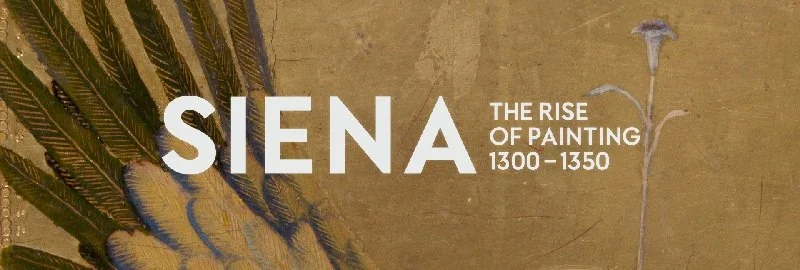
Like many people with an unhealthy obsession with both medieval history and modern politics, I found myself one sunny bank holiday Monday at Siena: The Rise of Painting at the National Gallery, and promptly lost my mind; ecstatically and in gold leaf.
Siena in the 13th and 14th centuries was not just a picturesque hill town with good wine. It was a city-state that sat like a brooch on the shoulder of the Silk Road, a cultural and political hub in an age when most of Europe thought that a drafty keep was the height of sophistication.
Its government, astonishingly for the time, was a semi-representative oligarchy - the Council of the Nine - who governed the city and brought stability in a time of upheaval across Europe. It was civic, sophisticated, and very interested in painting.
The not so different Mediaeval world
What struck me, wandering between crucifixions and Madonnas, is the similarities between their world and ours. Yes, it was soaked in religious devotion and occasionally in actual blood, and yes, their understanding of perspective in painting was lacking - giving the paintings that odd distinctively Mediaeval look - but they got something we don’t: they understood that power is not just violence. It’s image.
Sienese painting was political, not just in the banal sense that all art is political, but in the active, scheming, soft-power sense. Art was a tool of government. Simone Martini wasn’t just painting saints, he was helping invent the modern state.
Take The Mystic Marriage of Saint Catherine from the circle of Simone Martini. Gold. Everywhere. Gold that defies earthly logic, applied in ways that made me squint and think of offshore accounts. The point was not realism, but symbolism. Holiness gleamed. Power radiated. Saints wore Sienese silk. Catherine marries Christ, yes, but she does so wearing the high fashion of 14th-century Tuscany. This isn’t a history painting; it’s a political broadcast.
The modern political playbook
Look at The Marriage of the Virgin by Gregorio di Cecco di Luca. Mary and Joseph are getting hitched in a building that looks like the Palazzo Pubblico, again wearing the fashion of Siena at the time and not ancient Judah. They are dressed like wealthy merchants' children. This is not just anachronism; this is ideology. Siena was claiming spiritual legitimacy by inserting itself into the biblical story.
This is the same playbook as modern political spin doctors who want nothing more than to see a politician posing in a hard hat next to the construction site of some vast infrastructure project.
The cusp of the Renaissance
What’s more, this exhibition reminds us that they understood representation, both in painting and politics, as something revolutionary. Before the invention of linear perspective, these painters still reached toward a representation of the world that would be well understood at the time.
Madonna del Latte by Ambrogio Lorenzetti shows the Virgin nursing, not enthroned in majesty but as a mother, vulnerable and earthy. There is tenderness. Humanity. This is proto-humanism with gold halos.
Siena was on the cusp of the Renaissance, not just artistically, but civically. Its painters were working at the same time as Petrarch was inventing the idea of the individual. Martini even knew him personally. Imagine that, your local council commissioning art that philosophically aligns with the birth of humanism. Meanwhile, ours are still trying to get a recycling bin that works.
Not by sword, but by triptych
Then there’s the Avignon connection. When the papacy decamped from Rome to France, like a teenage runaway to a cooler friend’s house, it took the prestige of Sienese painting with it. Cardinals, kings, and power-hungry prelates all encountered this new kind of image-making, gilded, emotive, structured like a sermon but glowing like a Gucci ad. They copied it. They spread it. This was international influence, not by sword, but by triptych.
It made me think, uncomfortably, about how little regard we have now for the unquantifiable power of art. In our era of growth forecasts and spending reviews, we forget that civic pride, national identity, and even foreign policy can hinge on culture. Siena didn’t. They used painting like a scalpel; delicate, beautiful, and potentially fatal. We, on the other hand, treat it like an optional extra, to be cut when budgets tighten. Soft power isn’t in the balance sheet, so it doesn’t count. Until it does.
Painting in gold
The medieval world, for all its plagues, superstition, and saints with implausibly dainty hands, had a clearer understanding of how power works than we do. It knew that violence is only part of the story. Influence - the kind that lives in churches, in galleries, on screens - is subtler and stronger. It leaves fewer bruises, but longer memories.
So yes, their world was brutal, but at least they looked it in the face. If you think our world is less violent, then ask the people of Gaza what they think. We hide our brutality behind euphemisms and bury it in the endless scroll of social media. Siena painted theirs in gold.