Use of Weapons: Reading something new for the last time
Five years ago my favourite writer, Iain M. Banks, passed away. With his passing the world seemed a little duller, a little less fantastic. At the time, I wrote an obituary, which stated that there was only one Iain M Banks book that I hadn’t yet read. I was saving this book, as once I had read it there would be new more new words from Banks left for me to read.
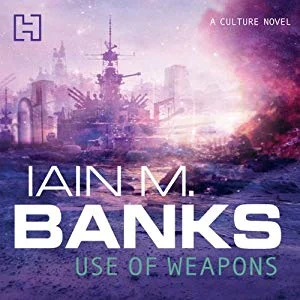
Five years later, I decided to sit down and read this novel, as it seemed like a fitting way to mark the passing of five years since his death. The book was Use of Weapons, the third novel in Banks's ‘Culture’ series, which is a loose collection of novels that can be read in any order. So, for the last time, I read something of his for the first time.
Banks had a amazing imagination for science fiction. It comes to life in the small details of his writing as well as the big sci-fi concepts. Every one of his novels has unusual aliens, incredible locations or bizzare space ships. Use of Weapons is a fine example of his rich and complex vision, with the novel taking place across several different worlds, ships and space habitats, all of which are rendered vividly.
Banks also wrote literary fiction under the name Iain Banks, and his science fiction has some literary experimentation to it. Use of Weapons has an unusual structure as there are two narratives, one of which moves forwards in time and the other backwards. I found this to be confusing at first, but after a few chapters I got use the two narratives spinning forwards and backwards form their crossover point at the start of the novel.
Thus, the climax of the novel is also the beginning. The reader gets the conclusion and inception of a series of events in two hard-hitting final chapters that are very powerful. Banks is more experimental in his prose than a lot of science fiction writers, but he also had a wicked sense of humour that comes through in the dialogue of this novel. The seriousness of the literary experimentation is well-balanced against this humour.
Another interesting feature of the novel is how the focus change as it goes along. Use of Weapons starts out being very plot-focused. Culture agent Diziet Sma is taken away from an important diplomatic summit to find an old operative of hers, Cheradenine Zakalwe, who might be the only person who can stop a war that threatens to engulf an entire star cluster. As the novel develops, the focus shifts from this race against time to stop a conflict, into a study of Zakalwe’s character and how his traumatic youth made him the person who he is. The fate of cluster is left ambiguous at the end and the final chapters focus on Zakalwe’s life.
There are gut-wrenching revelations at the end of the book. I won't spoil them here, but the ending of Use of Weapons is a prime example of two techniques of which Banks was a master. The ‘act three twist’ that redefines what you have just read, and grotesque body horror, vividly described for maximum impact. These two work best together, as they do in Banks's debut literary novel. The Wasp Factory, and in Use of Weapons the final few chapters manage to combine body horror and a twist to leave the reader reeling. The ending of Use of Weapons could be one of Banks’s most gruesome scenes, and that’s really saying something.
All of Banks's novels are political to a greater or lesser extend. The Culture novels, for example, focus on a far-future utopia where machines facilitate a society for humans that has no laws, property, inequality, scarcity, crime, prejudice or want. Even death has been conquered in the Culture, leaving people free to pursue, art, culture, extreme sports and headism in all its forms. The Culture's only flaw is its need to meddle with other societies to improve them, ie make them more similar to the Culture.
Banks was one of the most interesting writers of utopias and leads the reader to question the assumptions we would make about whether the Culture is a perfect society. Use of Weapons looks at the rights and wrongs of the Culture interfering in wars, or situations that might become wars. The novel asks whether the Culture has the right to meddle in such a way, even when it has the best of intentions? Banks offers no firm conclusions to these questions, as do all great literary writers, but he does leave you asking lots of questions.
Use of Weapons was published in 1990, but the debates at the heart of the book are as relevant today as they were then. Wars are raging in Syria and Yemen, and people in the West need to ask themselves: if we are responsible for these conflicts and what are our moral obligations to the people caught in the middle of them?
Banks packs a lot of complex political ideas into an accessible novel that has spectacular action scenes as well as interesting debates. Reading his novels has helped to shape my politics. I read my first Iain M Banks novel, just out of university and still naive about the world. Banks’s passion for a better future and his love for humanity come through in stories that embrace the complexities of our world.
Banks's writing shows that despite the fact that we often fail, we can be better than we are. His stories tell us that in the future we can move past the problems of today and live fuller, happier lives. I’m glad that I have had his novels in my life, even if now there will be no more new stories for me.