Red Train Blog

Ramblings to the left

The Red Train Blog is a left leaning politics blog, which mainly focuses on British politics and is written by two socialists. We are Labour Party members, for now, and are concerned about issues such as inequality, nationalisation, housing, the NHS and peace. What you will find here is a discussion of issues that affect the Labour Party, the wider left and politics as a whole.

  • Home
  • Topics
    • Topics
    • EU referendum
    • The Crisis in the Labour Party
  • Art
  • Books
  • About us
  • Search
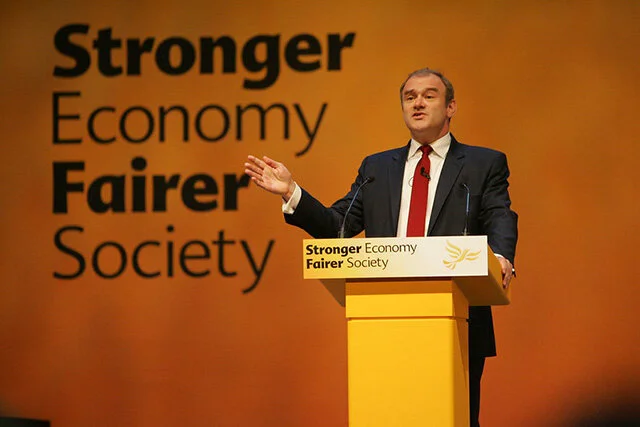
Ed-Davey.jpg

The election of Ed Davey shows the Lib Dems are happy being a centrist party

September 08, 2020 by Alastair J R Ball in Liberal Democrats

Ed Davey has been elected the new Lib Dem leader. The man who previously lost in a runoff to Jo Swinson (remember when the chronically misinformed thought that she would be the next Prime Minister?) is now in charge of Britain’s third party and, who knows, might one day be the doormat junior partner in a coalition government. Although he’s more likely to be remembered the same way the last four Lib Dem leaders are, as hardly worthy of a footnote in history. 

What can we learn from Davey’s victory? We can infer that the Lib Dem’s members are happy with their party being thought of as in the middle of the political spectrum. Their hope is that, as Labour have become more left-wing in recent years and the Tories have become more right-wing, they can win over more voters who feel abandoned in the centre.

Leaving Brexit behind

It also shows that they are moving away from an ultra-Remain position and returning to the Nick Clegg era of appealing to centrists. During the years of uncertainty over Brexit, the Lib Dems adopted the extreme position of stopping Brexit without another referendum if they became the government.

I call this extreme because it’s anti-democratic, as it’s possible to have a stable majority government with around a third of the vote, as Labour managed in 2005 when Tony Blair won 403 seats with 35.2% of votes cast. This Brexit stance was so extreme that I’m surprised that it didn’t receive more criticism. I’m also surprised that it was taken as a serious possibility by anyone.

The road not chosen

To win the unenviable position of being Lib Dem leader, Davey had to beat Layla Moran who, had she been chosen as leader, would have indicated that the Lib Dems wanted to attack Labour from the left, perhaps in a return to the Charles Kennedy days when the Lib Dems were more radical than Labour on some issues.

The argument is that Labour cannot afford to be too socially liberal. Having a metropolitan, middle-class position on issues such as patriotism and identity, and not connecting with how the majority of the country saw these issues, was seen as a major failure of Jeremy Corbyn. If Keir Starmer wants to win back the Red Wall voters who switched to the Conservatives in 2019, then he may need to at least pay lip service to views on these issues that will put him at odds with the average young, middle-class city dweller.

A left-wing culture war?

Had Moran won, it would raise an interesting question: do the Lib Dems think they could start a culture war from the left? Could they adopt positions on statue removal or defunding the police that are to the left of where the general public are, but in line with the social values of the average Corbyn supporting Labour voter? Would attempts lure away young voters put pressure on Kier Starmer, who has to walk an awkward tightrope of trying to keep both socially liberal and socially conservative Labour voters happy?

I think this was unlikely to work. One reason why the right-wing culture war has been so successful is that right-wing newspapers and right-wing social media pick up any story that could enrage social conservatives and amplify it until leading politicians have to respond. I think the Lib Dems will be unwilling to find many publications willing to support this.

Even the left-leaning media in Britain is not sympathetic enough to the rights of trans-people, ethnic minorities or the young to give a left-wing culture war the energy it needs to succeed. Nor are they ideologically committed enough to the Liberal Democrats (or Labour for that matter) to consistently amplify stories that are useful to them.

Happy in the centre

Also, the Lib Dems tried the approach of adopting a position out of step with the majority, but highly in line with young social liberals, on Brexit and it didn’t work. Mainly because their record in the coalition still makes them toxic to these voters. This approach failed even when supported by a left-leaning media that was in favour of stopping Brexit.

Being in the middle makes more sense for the Lib Dems. In 2019 they came second in many Labour and Tory seats and are unlikely to win back the young any time soon. Choosing Davey as a leader and adopting this positioning makes sense.

Two Sirs and Boris Johnson

I don’t think Keir Starmer or Boris Johnson will be losing any sleep now that Ed Davey has become Lib Dem leader. He isn’t a threat to either of them. Although Boris Johnson must be annoyed that both opposition leaders are Knights and he’s not.

If the Lib Dems think there are loads of centrist voters to win over, and that will propel them back to the level where they can sell out all their values to the Tories for another electoral reform referendum that will be lost, then good luck to them. I don’t think this centre ground exists or is stable enough to achieve this, but I have been wrong in the past.

Broadly, I don’t see much changing from the Lib Dems. Moran would have certainly been a more interesting choice for leader, but perhaps a period of stability with clearly defined left, right and centre parties is what the country needs after three years of slow-motion chaos.

"ed davey speech 01" by Liberal Democrats is licensed under CC BY-ND 2.0

Related posts
Oct 31, 2025
Farage’s new immigration plan is cruelty as a governing principle
Oct 31, 2025
Oct 31, 2025
Trump-rally.jpg
Sep 30, 2025
Dr. Strangelove goes to Tehran: The hottest new war nobody ordered
Sep 30, 2025
Sep 30, 2025
Sep 16, 2025
The right finally discovers that life sucks for Millennials, but guess who they still blame
Sep 16, 2025
Sep 16, 2025
960px-Official_portrait_of_Angela_Rayner_MP_crop_2,_2024.jpg
Sep 9, 2025
Rayner’s resignation is another unforced error from Labour
Sep 9, 2025
Sep 9, 2025
Union-Jack.jpg
Aug 20, 2025
Who really holds power? The cultural illusion of middle-class dominance
Aug 20, 2025
Aug 20, 2025
Labour Party in parliament.jpg
Aug 2, 2025
What would Max Weber make of our politicians?
Aug 2, 2025
Aug 2, 2025
Jul 28, 2025
Why social media platforms spread the worst political messages
Jul 28, 2025
Jul 28, 2025
Trump-rally.jpg
Jun 20, 2025
Elon Musk and Donald Trump: The Beavis and Butt-Head of right-wing edge lords
Jun 20, 2025
Jun 20, 2025
Capitalism.jpg
May 27, 2025
“That’s Your GDP”: Labour’s big growth delusion
May 27, 2025
May 27, 2025
nigel farage.jpg
May 15, 2025
Nigel Farage is seriously uncool
May 15, 2025
May 15, 2025
September 08, 2020 /Alastair J R Ball
Liberal Democrats
Comment
Boris-Johnson.jpg

Why incompetence isn’t damaging the Tory brand

August 25, 2020 by Alastair J R Ball in Boris Johnson

The Tories are known for their ruthless efficiency, be it in dispatching leaders who aren’t working out or in making difficult decisions in government. From Winston Churchill, to David Cameron via Margaret Thatcher, the Tory brand is built around having the strong leadership to sort the country out.

This is a simplistic, right-wing reading of history, which I strongly disagree with, but it tells us something about how the Tories sell themselves to the electorate. They want to be seen as a competent party of government. Socialism may sound nice and lovely for everyone, but it leads to queues at shops and strikes in factories. Toryism may not be cuddly, but it keeps the lights on and food on the table.

This may be how the Tories would like to be seen, but it isn’t how things have worked out for Boris Johnson’s government. England had the largest increase in deaths from Covid-19 in Europe, the economy suffer Biblical devastation in April with the growth rate at negative 20%, whilst the A-Level results scandal went from a debacle to a disaster and forced the government into an embarrassing U-turn.

Tory incompetence

Things are not going well for the Tories. As usual, Gary Younge said it best when he tweeted: “I expected the Tories to be this mendacious, elitist and corrupt. I genuinely did not expect them to be this incompetent.”

Despite all of this, the Tories remain ahead in the polls with 42% saying they are likely to vote Tory in a hypothetical election and 37% Labour at the time of writing. This level of incompetence should be poison to the Tory brand, but it isn’t.

The new Tory brand

This is because the Tory brand has changed. They’re no longer the party of “making tough decisions” and not being compromised by things like human emotions, which was their brand up until Cameron left office. Now they’re more of a culture war movement than a party that sells itself on a record of competence in government.

The Tory Party has become a movement for people who love Brexit, are patriotic and hate immigration. They are a movement that is anti-woke, anti-BLM, anti-London, anti-craft beer and anti-dance videos on TikTok (or whatever it is 20 somethings are into these days). You can see this when Johnson recently demanded an end to the "cringing embarrassment about our history" by which he means an end to anyone questioning a version of British history where Britain is always the hero, which is fixed in the mind of Tory voters across the country and is free from any nuanced understanding of our national history. 

Around 40% of the country want a pro-Brexit, pro-flag waving, anti-immigration party, or hate the woke lefties enough to support the Tories no matter what. This has given them a floor in the polls of roughly 40% that the Tories don’t fall below regardless of how weak Theresa May was or how out of depth Johnson is. This 40% of mainly old, mainly outside cities, mainly non-university educated, mainly pro-Brexit, mainly white, conservative voters’ desire for a government that reflects their values and sneers at their opponents’ won’t be shaken by incompetence, especially when the government can point to boatloads of immigrants arriving to fire their supporters up.

Labour’s response

What does this mean for Labour? Appearing competent or saying that Labour would run the country better is a good start as there are some voters who will be won over by this. This involves Labour articulating a vision of how the country will be different with them in charge, something that has been sadly lacking from Keir Starmer. Instead, Labour have simply pointed out that the Tories have messed up after all of their recent mess ups which has, unsurprisingly, not moved the polls. 

What’s more important is that Labour needs to find a way to avoid being drawn into a culture war over statues being torn down or songs being sung at the Proms. If Labour are going to break the Tories’ 40% floor then they need to be able to outline their vision for transforming the country and improving everyone’s lives without being drawn into debates on social issues that remind the Tory 40% which side they are on.

Land of hope and anti-wokeness

A recent example of this is the arguments over singing Land of Hope and Glory and Rule Britannia at the Proms. This is a largely manufactured controversy that serves only to convince cultural conservatives that they and everything they love is under attack from young woke people.

As a sidebar: even in the wokest corners of Twitter, I have never heard anyone object to Land of Hope and Glory or care what is sung at an outdated celebration of British nostalgia, such as the Last Night of the Proms. We’re all too busy worrying about how many people will die when the Tories force us to go back to our office jobs because they don’t want Subway to fold.

It’s not an enviable position Labour is in, having to walk on eggshells to avoid triggering a lot of Boomers who are very sensitive about cultural issues and believe that young people (by which I mean everyone under 45) are trying to create a Brave New World: a society without history where everyone is constantly zoned out on legalised drugs. However, the country shows no sign of tiring of culture wars.

Labour needs to find some way of neutralizing these issues whilst articulating how it would transform the country into a place where everyone can have a job, a measure of dignity and doesn’t live in fear of a killer a virus - or at least believes that the government is doing everything in its power to safeguard its citizens. If Labour can’t do this, they won’t be able to close the poll gap, regardless of how incompetent the Tories are.

"Boris Johnson at Conservative Party Conference" by conservativeparty is licensed under CC BY-NC-ND 2.0

Related posts
Oct 31, 2025
Farage’s new immigration plan is cruelty as a governing principle
Oct 31, 2025
Oct 31, 2025
Trump-rally.jpg
Sep 30, 2025
Dr. Strangelove goes to Tehran: The hottest new war nobody ordered
Sep 30, 2025
Sep 30, 2025
Sep 16, 2025
The right finally discovers that life sucks for Millennials, but guess who they still blame
Sep 16, 2025
Sep 16, 2025
960px-Official_portrait_of_Angela_Rayner_MP_crop_2,_2024.jpg
Sep 9, 2025
Rayner’s resignation is another unforced error from Labour
Sep 9, 2025
Sep 9, 2025
Union-Jack.jpg
Aug 20, 2025
Who really holds power? The cultural illusion of middle-class dominance
Aug 20, 2025
Aug 20, 2025
Labour Party in parliament.jpg
Aug 2, 2025
What would Max Weber make of our politicians?
Aug 2, 2025
Aug 2, 2025
Jul 28, 2025
Why social media platforms spread the worst political messages
Jul 28, 2025
Jul 28, 2025
Trump-rally.jpg
Jun 20, 2025
Elon Musk and Donald Trump: The Beavis and Butt-Head of right-wing edge lords
Jun 20, 2025
Jun 20, 2025
Capitalism.jpg
May 27, 2025
“That’s Your GDP”: Labour’s big growth delusion
May 27, 2025
May 27, 2025
nigel farage.jpg
May 15, 2025
Nigel Farage is seriously uncool
May 15, 2025
May 15, 2025
August 25, 2020 /Alastair J R Ball
Boris Johnson
Comment
Keir_Starmer.jpg

It’s a mistake for Labour to want to talk about race and economic issues separately

July 28, 2020 by Alastair J R Ball in Identity politics, Political narratives, Starmer

How should Labour respond to the recent Black Lives Matter protests across the UK? I know how I feel about them: systematic racism is a big problem in the UK, you just have to look at the higher death rates from Covid-19 for people from Black and minority ethnic (BAME) groups people to know that the UK has a problem. I want the Labour Party and its leadership to be a vocal supporter of the Black Lives Matter movement and work to dismantle systemic racism wherever it is found.

One of the sad things about politics today is that there are voters who would be put off voting Labour if Keir Starmer became a prominent supporter of BLM. Part of me wants to say “fuck those guys, we don’t need them.” However, I don’t know if Labour can win power by only appealing to people who support BLM. It seems unlikely. 

Labour needs to win an election to be in power so that it can implement meaningful reforms that address systemic racism. For example, Labour could carry out the recommendations of the Lammy Review: “An independent review into the treatment of, and outcomes for, Black, Asian and Minority Ethnic individuals in the Criminal Justice System.” The Tories aren’t going to do this, but Labour needs to win power first.

Conscience against compromise

This leads to the age-old political dilemma: conscience against compromise. Say what you feel or play a tactical game to win power and then make changes. I don’t envy the position that Starmer is in. Making the wrong strategic decision on BLM, or a host of other issues, could hurt Labour’s electoral chances, prevent them from winning power and then using the power of the state to address systemic racism in Britain.

It appears that Starmer has chosen compromise. He was photographed taking the knee, in a show of solidarity with those protesting the murder of George Floyd by police in the US, but he also criticised the removal of a statue of slave trader Edward Colston in Bristol. I can see the pragmatism in this approach, it aims to keep onside voters who support the removal of the statue and voters (and potential voters) who weren’t in favour of it.

It’s worth bearing in mind that a recent YouGov poll showed that 40% of those asked supported “the statue being removed, but not in the way in which it was done” and that 33% “disapprove of the statue being removed.” This could be read as 73% of voters being opposed to the toppling of the statue. It’s a courageous Labour leader who takes a stance that 73% of the voters oppose, so I can see why Starmer has opted for compromise here.

Identity politics

It’s also worth remembering that the Edward Colston statue is just one event in a long campaign against systemic racism. A single poll on one event doesn’t mean that Labour should be shouting loudly about keeping up statues of slave traders. The poll does highlight one of the key problems for Labour: what is the story that they can tell that will unite Labour voters who were glad to see the statue torn down and those who would want to see it staying up?

The discourse around events such as the removal of the Edward Colston statue are often referred to as “identity politics”. This phrase is usually evoked by people opposed to “identity politics” as a way to dismiss the voicing of objections to systemic racism or the oppression of LGBTQ+ people. However, there are a lot of voters who are alienated by identity politics and Labour might need to win some of their votes to be in power.

There is a view within the Labour Party that it needs to stay away from issues related to identity, from Black Lives Matter to trans rights, and instead tell a story that is entirely about economics.

An economic message

A form of this argument is made in the recent report from Labour Together into the 2019 election defeat, which concludes: “Our potential voting coalition shares much common ground on economic issues”. This argument is also made in Steve Rayson’s new book about the 2019 general election: The Fall of the Red Wall.

Both of these investigations into the future of Labour recommend a focus on economic issues over identity issues. The reason is that the party’s current supporter’s beliefs on identity are divergent from the rest of the country. Only a story about a radical economic change can unite its current supporters with the supporters the party needs to win, because they are so far apart on other issues.

Race and class

It is a mistake to think that Labour can win power by telling a story about the country they want to create that is only focused on economic issues, while either talking separately about racial equality or ignoring it all together. Gary Younge recently wrote in the New Statesman that he wanted the left to “end the futile attempts to engage race and class separately.” He said: “They do not exist in silos but are two interdependent forces, among many, and they are either understood in relation to each other or are misunderstood completely.”

In his article Younge talks about how people from the BAME community are more likely to be in poorly paid service industry jobs that make them more at risk from Covid-19. He said: “For historical reasons, related to migration, some groups are more likely to be concentrated in the health service, public transport and care work, while the modern economy has created significant concentrations of certain ethnicities in cleaning, taxi driving and security.

“12.8 per cent of workers from Bangladeshi and Pakistani backgrounds are employed in public-facing transport jobs such as bus, coach and taxi driving, compared with 3.5 per cent of white people. These are all areas where workers are most at risk.”

Measures to improve the conditions for people in low paid, service industry jobs fit perfectly into the economic story that Labour wants to tell about the country, but are also part of the story about racial equality that Labour feels it needs to sideline. The two issues are fundamentally linked and can’t be talked about separately. Pushing discussion of racial equality to one side and labeling it as “identity politics” is a failure to understand the details of the story that Labour needs to tell.

Informing, not undermining, solidarity

As Younge said in his article: “The effort to relegate race, gender, sexual orientation, disability – the list goes on – to mere “identity politics” has ramped up of late. The disproportionate number of deaths among minorities, the spike in domestic violence during lockdown, the manner in which disabled people were marginalised at every step – all these factors exemplify the degree to which we have experienced this moment differently in material ways that are not, solely, about economic. Acknowledging that doesn’t undermine solidarity, it informs it.”

Labour should urgently find a story that it can connect racial equality with its economic message. Talking about racial equality is not separate from discussing jobs, education, health, economic distribution and regional inequality, all issues that Labour need to be talking about as part of their economic message to the voters. The two issues are fundamentally connected. There’s no need to separate out the “identity politics” that some voters don’t like from the economic message that they will like.

Labour needs to tell a powerful story that connects the reasons why it’s wrong that we had a statue of a slave trader in Bristol, to reasons why we have so much regional variation in job prospects, all the way through to why the economic gap between rich and poor is growing. Labour cannot tell a story that addresses some of these questions separately. It needs to tell a story that addresses them all together.

"File:Official portrait of Keir Starmer crop 1.jpg" by Chris McAndrew is licensed under CC BY 3.0

Related posts
Sep 16, 2025
The right finally discovers that life sucks for Millennials, but guess who they still blame
Sep 16, 2025
Sep 16, 2025
Union-Jack.jpg
Aug 20, 2025
Who really holds power? The cultural illusion of middle-class dominance
Aug 20, 2025
Aug 20, 2025
Apr 12, 2025
How should the left view the porn industry?
Apr 12, 2025
Apr 12, 2025
Books.jpg
Mar 28, 2025
Behold the smartest people in the room: The Waterstones Dads
Mar 28, 2025
Mar 28, 2025
Feb 18, 2025
Russell Brand isn’t the only person on the hippy to alt-right pipeline and the left should be aware of this
Feb 18, 2025
Feb 18, 2025
polling-station.jpg
Dec 3, 2024
Steve Rayson’s Collapse of the Conservatives shows how Labour benefited from voters’ volatility but may also suffer from it
Dec 3, 2024
Dec 3, 2024
nigel farage.jpg
Aug 13, 2024
The rhetoric from mainstream politicians on migration caused these riots
Aug 13, 2024
Aug 13, 2024
IMG_4111.JPG
Mar 19, 2024
The discourse around extremism is based on hand waving at best and Islamophobia at worst
Mar 19, 2024
Mar 19, 2024
Tony-Blair.jpg
Sep 26, 2023
What does Tony! [The Tony Blair Rock Opera] tell us about how the Blair era is remembered?
Sep 26, 2023
Sep 26, 2023
8644221853_6af3ffe732_c.jpg
Aug 22, 2023
The cost of living crisis isn’t recent and has deep roots in the economy
Aug 22, 2023
Aug 22, 2023
July 28, 2020 /Alastair J R Ball
Covid-19
Identity politics, Political narratives, Starmer
Comment
Labour Party.jpg

The Fall of the Red Wall by Steve Rayson shows the role that narrative played in Labour’s defeat

July 20, 2020 by Alastair J R Ball in The crisis in Labour, Political narratives

When the votes were counted after last year’s general election, and the Tories had won 41 historic Labour seats in the North and Midlands, it became clear that a realignment in politics had happened. 

Some of these seats had returned Labour MPs for over 100 years and were now returning Tory MPs despite being blighted by deindustrialization under Margaret Thatcher and austerity under David Cameron. Now that the dust has settled, we can begin to ask: why were ex-coal miners and factory workers turning their backs on Labour and voting Conservative?

This is the subject of a new book by Steve Rayson that is published today. The Fall of the Red Wall: 'The Labour Party no longer represents people like us' doesn’t seek simple answers to the complex question of how politics appeared to change so much in such a short time. It doesn’t reach for the obvious answers of “Brexit” and “Jeremy Corbyn”, but locates these in a wider story of social and political changes that were all brought to a head in December 2019.

The role of narrative

Rayson has conducted a lot of detailed research and thoroughly explains the causes of the fall of the Red Wall. He draws on a range of sources, from academic research to statements made by MPs, to focus groups, to polling, to articles by journalists. The book is certainly comprehensive. Rayson makes a lot of good points about what happened during the last election, but to save time I’m going to focus on the element that interested me the most: the role that narrative played in the fall of the Red Wall.

In Rayson’s words: “In traditional Labour constituencies across the Midlands and the North, a ‘never Tory’ generation put aside historic narratives of being Labour towns and Labour people and voted for the Conservatives.” He details how the dominant narrative of “Labour towns and Labour people” was defeated by a challenger narrative of “the Labour Party no longer represents people like us”. Again, this wasn’t caused by Brexit and Corbyn, although both were factors.

For many decades the “Labour towns and Labour people” narrative had been weakening until it finally broke in the last general election. Many Red Wall voters’ sympathies had been with the Tories for some time, but they kept voting Labour because of the “Labour towns and Labour people” narrative. It required a certain number of people to publicly voice their support for the Conservatives for the taboo of voting Tory to be broken. New stories about the Tories surging in the polls in former Red Wall seats finally caused the “Labour towns and Labour people” narrative to collapse and voters’ preferences for the Tories to be revealed.

A long decline

The decline of the “Labour towns and Labour people” narrative can be traced back to the 1980s and the decline of the trade unions that maintained this narrative. It was weakened by New Labour who pursued a new coalition of voters - more middle-class, more affluent, more centrist - and didn’t engage as much with Red Wall voters. New Labour thought they had no one else to vote for and, for a long time, they didn’t. This led to Red Wall voters feeling at best taken for granted or at worst looked down on by Labour’s metropolitan leadership.

This narrative was further weakened by people who were likely to have a strong preference for Labour leaving these constituencies. Younger, more liberal and more educated voters have moved to large cities where there are better job prospects. This had led to a demographic shift in Red Wall seats, making them older, less well educated and more socially conservative: i.e. much more like the typical Tory voter.

Rayson writes about how political changes also made it easier for voters to switch parties. Voters are more volatile now, Rayson writes: “party loyalty has declined over many years and we now live in an increasingly volatile political world. In the 2017 election 33% of people changed their vote from 2015. Over the four elections from 2005 to 2017 around 60% of people voted for different parties.”

Rayson also argues that more elections (EU elections, local elections, mayoral elections, referendums) make it easier for voters to experiment with switching parties before a general election. There is also the possibility of UKIP or the Brexit Party offering a half-way house for voters switching from Labour to the Tories. 

What next?

The Fall of the Red Wall mainly describes what happened, which is essential reading for anyone who cares about the fate of the Labour Party. What I was most interested in is the book’s final part: what next?

Rayson states that Labour needs a new narrative, which I strongly agree with, and that the lack of a coherent narrative was a major weakness of the 2019 campaign. He also agrees with a recent Labour Together report (which he cites in his book) that Labour needs to focus on an economic message, as left-of-centre economic views and dissatisfactions with our current economic system is one thing that unites the various disparate groups that Labour needs to win the votes of to get back into power.

The Fall of the Red Wall also makes the case that this needs to be more than a message, it needs to be a narrative. The story that Labour needs to tell must run deeper than economics, it needs to take into account how voters in the Red Wall and beyond see the world, their fears and their aspirations for the future. The story that Labour needs to tell needs to unite people in a shared vision of the country a Labour government will create.

Cultural divide

There are many challenges to this. Rayson states that: “in developing a new narrative Labour has to be cognisant of a significant divide on cultural issues. Analysis by Datapraxis for the Labour Together review indicates this divergence on social and cultural issues [between Red Wall voters and 2019 Labour voters] is growing. This presents a major challenge for Labour in developing a narrative that realms the audience’s sense of identity and reflects a sense of shared values.”

Rayson is not the first writer to point out the difference in values between former and current Labour voters. The generational aspect of this divide is not discussed enough, nor is the fact that Labour needs to hang on to young voters as the party's future and their activist base.

I was also hoping for more details of what the different values are, beyond the clear differences in views on patriotism, law and order and immigration. Understanding exactly what the values difference is will be crucial for the new Labour narrative.

Moving to meet Red Wall voters where they are

It’s not enough to just to look at how Labour’s current supporters are out step with the rest of the country on the issues of patriotism, law and order and immigration. The book shows that the voters in these Red Wall seat’s economic views are far to the left of the median voter, but their social views are far to the right. This allowed the Tories to appeal to them on social grounds with a message of Brexit, toughness on crime, and patriotism. 

Rayson makes a strong case about moving to meet Red Wall voters on social issues could alienate many voters because of how far to the right Red Wall voters are on social issues. This books chimes with a recent article by Lynsey Hanley who argues that: “Labour will win by changing minds – not pandering to rightwing voters” and is part of a wider body of evidence that Labour shouldn’t jump to the obvious conclusion from the loss of the 41 Red Wall seats.

Labour needs to know how to speak to Red Wall voters in a way that resonates with them. If Labour focuses simply on issues like patriotism, law and order and immigration to win back Red Wall voters they risk alienating the median voter (as well as Labour activists) as Red Wall voters are significantly to the right of the median voter on these issues.

My view on the narrative that Labour needs

The story that Labour needs to tell needs to offer more than moving the party closer to where the median voter is on the issues of patriotism, law and order, and immigration. Labour can wave the flag more, talk up the police (additional police has been Labour policy under Ed Miliband’s and Corbyn’s leadership) and bring back their “controls on immigration” mugs, but this won’t be enough to win over Red Wall voters.

I don’t think that many voters see a difference between what Miliband and Corbyn stood for in terms of patriotism, crime and controls on immigration. The difference between the two might have defined Labour’s civil war for the last five years or so, but from the outside it looks like Judean People’s Front Politics. Is Starmer seen as any different? He might be closer to the average voter (if not the Red Wall voter) on these issues, but is that a meaningful enough change?

My concern is that Labour is not appreciating the huge task ahead to winning back the votes that have been drifting away for most of my lifetime (and I’m not a young man). I don’t think that choosing Keir Starmer as Labour leader is a solution to the problems of Labour not being seen as representing Red Wall voters, despite the fact he’s from a different Labour tradition than Corbyn.

A step on the road towards reckoning with what went wrong

The publication of this book is a step on the road towards Labour reckoning with what went wrong last year. The detailed research and insights in this book highlight how the “Labour towns and Labour people” narrative crumbled. I hope this will be a wake up call to the fact that getting rid of Corbyn isn’t the answer to Labour’s problems. Labour needs a plan to win.

Understanding why the Red Wall fell and the role narrative plated in this fall is essential for understanding what Labour should do next. The Fall of the Red Wall is an essential tool for this as it outlines what the narrative that Labour needs to tell to start winning again might be like.

Labour is still a long way from having a strategy and narrative that can win. What The Fall of the Red Wall shows is that Labour needs to understand what went wrong and then start thinking about how to fix the problem. 

The Fall of the Red Wall: 'The Labour Party no longer represents people like us' is out today and can be purchased from Amazon.

Labour Party picture taken by Andrew Skudder and used under creative commons.

Related posts
Sep 16, 2025
The right finally discovers that life sucks for Millennials, but guess who they still blame
Sep 16, 2025
Sep 16, 2025
Union-Jack.jpg
Aug 20, 2025
Who really holds power? The cultural illusion of middle-class dominance
Aug 20, 2025
Aug 20, 2025
Apr 12, 2025
How should the left view the porn industry?
Apr 12, 2025
Apr 12, 2025
Books.jpg
Mar 28, 2025
Behold the smartest people in the room: The Waterstones Dads
Mar 28, 2025
Mar 28, 2025
Feb 18, 2025
Russell Brand isn’t the only person on the hippy to alt-right pipeline and the left should be aware of this
Feb 18, 2025
Feb 18, 2025
polling-station.jpg
Dec 3, 2024
Steve Rayson’s Collapse of the Conservatives shows how Labour benefited from voters’ volatility but may also suffer from it
Dec 3, 2024
Dec 3, 2024
nigel farage.jpg
Aug 13, 2024
The rhetoric from mainstream politicians on migration caused these riots
Aug 13, 2024
Aug 13, 2024
IMG_4111.JPG
Mar 19, 2024
The discourse around extremism is based on hand waving at best and Islamophobia at worst
Mar 19, 2024
Mar 19, 2024
Tony-Blair.jpg
Sep 26, 2023
What does Tony! [The Tony Blair Rock Opera] tell us about how the Blair era is remembered?
Sep 26, 2023
Sep 26, 2023
8644221853_6af3ffe732_c.jpg
Aug 22, 2023
The cost of living crisis isn’t recent and has deep roots in the economy
Aug 22, 2023
Aug 22, 2023
July 20, 2020 /Alastair J R Ball
The crisis in Labour, Political narratives
Comment
Extinction-Rebellion.jpg

Ecofascism, Malthusian economists and why we need less fearful stories about the environment

July 14, 2020 by Alastair J R Ball in Far right, Environment, Political narratives

Fear is a powerful motivating force. The fear of Covid-19 made us change our entire society very rapidly from one that seemed perfectly designed to spread the virus to one that is perfectly designed to contain it. 

It makes sense that fear would be a strong enough motivator to do the kind of society wide changes that are necessary to stop a climate disaster. The data tells a simple story: that if we don’t change our behaviour soon there will be huge impacts and massive suffering caused by climate change. Amping up the fear of this makes sense as a strategy to encourage the changes that are needed to prevent a climate catastrophe.

This seems self-evident, but decades of raising awareness in the hope that fear of a climate disaster would lead to a more environmentally friendly society have not worked. The story being told by the environmental movement has been consistent, but temperatures and CO2 levels keep rising.

Avoiding an oncoming train

A report from Futerra entitled Sell the Sizzle outlines the problems with a story that uses fear as a motivator for environmental action. The fear of danger is only a good motivator if the way to avoid danger is clear. The fear of an oncoming train works well as a motivator to avoid being hit by a train as the solution is simple: get off the train track.

A more recent example is Covid-19. Fear of coronavirus (and what it can do to society if it spreads unchecked) created social change because it's clear what you need to do to stop the spread of the virus: stay home. It’s that simple.

Sell the Sizzle says that when the solution to the frightening thing is not clear, the fear response produces a sense of resignation rather than action. Narratives about how we’re all doomed unless we change our lifestyles don’t work if it's not clear what we need to do.

Climate stories and white nationalism

The narrative of doom and gloom used by the environmental movement is creating more problems than just failing to motivate the change to society we need. It’s also feeding into the rise of far-right politics and white nationalism.

In an article for Gizmodo, Brian Kahn outlines the ways in which white nationalists have been using climate rhetoric. He describes Patrick Crusius, a white nationalist who killed 23 people in a mass shooting in El Paso, Texas, and a manifesto he posted on 8chan that contains “ideas central to the mainstream environmental movement.”

Crusius wrote: “[O]ur lifestyle is destroying the environment of our country. The decimation of the environment is creating a massive burden for future generations. Corporations are heading the destruction of our environment by shamelessly overharvesting resources.”

The rise of ecofascism

Kahn explains how rhetoric like that used by Crusius is part of a new trend in far-right politics towards “ecofascism,” a right wing ideology that links white nationalism with a twisted form of environmentalism. What ecofascism and the mainstream environmental movement have in common is they both tell a story of a society that is sick, dying and ultimately doomed. Both say: through our decadence we are destroying the world and we need to turn the clock back to a simpler, better time to avert a disaster.

The idea that stories about a looming environmental disaster should fuel the far-right makes sense when you think about how people react when they’re afraid. Fear of something bad happening can be a good motivator, to make someone stop smoking or go to the gym more, but fear also brings out the worst in us. It makes us act suddenly, or do things that if we were calmer we wouldn’t do.

Fear leads to other negative emotions such as anger and hatred. Anger at whoever caused us to be afraid. Hatred of the people who have awakened these fears. This is especially true when our fear relates to things like our homes, our children or our futures. Things we feel strongly about. Things that stories about environmental doom and gloom play off.

If everyone is afraid of environmental devastation in our future then they’re likely to want someone to blame, someone to be angry at or someone to hate. For a lot of people that is the corporations who have poisoned the planet or the politicians who have failed to constrain them. However, for some people their fear about the future is causing them to hate the people they already fear and hate: immigrants, poor people and people of colour. This is the fuel that sustains ecofascism.

“Overindulging in apocalyptic thinking”

In the Gizmodo article above, Kahn interviews Betsy Hartmann, a professor emeritus at Hampshire College, who studies the connections between white nationalism and environmentalism. Hartmann said: “There is a deeply problematic, apocalyptic discourse about climate and conflict refugees that is quite common in liberal policy circles and even documentaries.”

She also said: “The environmental movement in the U.S. has, I would say, overindulged in apocalyptic thinking for a long time. There’s that kind of apocalyptic bridge and then the nature-race-purity bridge. What’s so horrifying and shocking to me is that these [far-right] manifestos are openly Malthusian environmentalist arguments. I don’t think we saw that quite as much before in the armed white nationalist movement.”

18th century economists and 21st century problems

Mentioning Thomas Robert Malthus is interesting. Malthus was a cleric and economist who had “ideas” about the problems of a growing population. In his 1798 book An Essay on the Principle of Population, Malthus set out his thesis that people, mainly poor people, would breed and breed and there would not be enough food. 

Malthus predicted mass starvation in the near future and said that charity, or state aid, to help the poor would only make things worse as any attempt to alleviate the suffering of the poor would lead to more poor people and thus not enough food. The solution, according to Malthus, was to stop people breeding so much.

A lot of problematic environmental stories that are fueling ecofascism are descended from Malthus’s ideas. When we tell stories about how there aren’t enough resources on planet Earth to sustain the human race at the rate at which we consume, we risk drifting into telling Malthusian stories about how the problem is that there are too many people. This leads people to suggest 18th century economic solutions to 21st century problems, i.e. there should be less people. It’s easy to see how this fuels ecofascism.

A question of distribution

The problem with Malthus’s work is that it’s too mathematical. He only considered that there were too many people and not enough food. He didn’t look at the social or political reasons why there wasn’t enough food. He didn’t consider distribution or power structures that keep people hungry. 

Eleanor Penny said it best in a recent essay on Malthus when she said: “His problem is more fundamental: he framed human suffering as purely a scientific and mathematical question - recasting the effects of a brutal economic system as the dispassionate mechanics of nature. He rewrote a political problem of production and distribution as a biological problem of reproduction and consumption - distracting from its causes, exculpating its architects from any responsibility, and blinding us to possible solutions.”

Modern Malthusian environmental stories

The environmental stories we tell risk drifting into these overly simplistic Malthusian narratives that can fuel ecofascism. Stories that paint a picture of a world where poor people of colour have been driven from their homes by a climate disaster and have to move to richer, whiter nations are Malthusian.

These stories make us - those of us in wealthy countries - worry about how our nation will accommodate climate refugees. They make us worry that there won’t be enough to go around in the climate-addled future. They make us frightened of poor people, people of colour and migrants. They fuel ecofascism.

We tell these stories with good intentions, to motivate people to change the world for the better, but stories about climate refugees are only fueling the fear of migrants that spread white nationalism and fascism. If the story is that the problem with the environment is that there are too many people, then we all know what a fascist solution for the problem of too many people is.

Hartmann said when interviewed by Kahn: “Using this highly militarized and stereotyped Malthusian discourse about poor people of color is dangerous and counterproductive.” She added that: “I would say the internet and right-wing media certainly plays a role in spreading them. But we can’t ignore how Malthusian ideas about overpopulation and the environment are taught in high schools all over the United States.”

From Malthus to Michael Moor

The lesson to learn is that we need to tell stories about the environment that are more complicated. Stories that take into account social and political issues and not just the fact that we are consuming too much or that there are too many people.

There is a serious risk of the stories we tell about the environment - with the best of intentions of improving the world for everyone - spread a message that white nationalists and ecofascists can use to spread their ideas. Penny said: “Everywhere we read lazy affirmations that we are the problem; humanity and its fatal tendency to multiply is plundering the earth of its natural wealth.” Even Michael Moore is at it in his new documentary Planet of the Humans, which lays the blame for the worsening environment on there being too many people.

Somewhere to jump to

As the Sell the Sizzle report found, promoting fear without a plan a clear plan for what we’re changing into to avoid disaster doesn’t work. We can’t jump out of the way of the train without somewhere to jump to. If we are going to use fear of an environmental disaster in the stories we tell to motivate change then we need to identify where we’re jumping to. If it’s not clear, people will blame the wrong people or people in general for the looming environmental disaster, or reach for the usual scapegoats.

We need somewhere to jump to. We need to talk up the positive aspects of the new society that we are going to build that will be fairer, greener, healthier and happier.

Jumping towards a solarpunk future

Recent examples of stories about positive vision of a future can be found in solarpunk: an art, literary and design movement that is centered showing what a greener, fair future might be like. Its rebellion against the dystopian futures of cyberpunk, a genre very much concerned with frightening narratives about environmental devastation. Solarpunk gives us something to aspire to whilst showing us what a better future would be like.

There are many problems with fearful environmental narratives. They don’t motivate us to change society for the better, they promote at best nihilism about the future and at worst ecofascism. We need better environmental stories.

The solution to too much pessimism is some optimism. We don’t need stories with a naive optimism that things will just get better. We need stories that say that if we all pull together, a better world for everyone can be achieved.

"Extinction Rebellion-11" by juliahawkins123 is licensed under CC BY 2.0 

Related posts
Sep 16, 2025
The right finally discovers that life sucks for Millennials, but guess who they still blame
Sep 16, 2025
Sep 16, 2025
Union-Jack.jpg
Aug 20, 2025
Who really holds power? The cultural illusion of middle-class dominance
Aug 20, 2025
Aug 20, 2025
Apr 12, 2025
How should the left view the porn industry?
Apr 12, 2025
Apr 12, 2025
Books.jpg
Mar 28, 2025
Behold the smartest people in the room: The Waterstones Dads
Mar 28, 2025
Mar 28, 2025
Feb 18, 2025
Russell Brand isn’t the only person on the hippy to alt-right pipeline and the left should be aware of this
Feb 18, 2025
Feb 18, 2025
polling-station.jpg
Dec 3, 2024
Steve Rayson’s Collapse of the Conservatives shows how Labour benefited from voters’ volatility but may also suffer from it
Dec 3, 2024
Dec 3, 2024
nigel farage.jpg
Aug 13, 2024
The rhetoric from mainstream politicians on migration caused these riots
Aug 13, 2024
Aug 13, 2024
IMG_4111.JPG
Mar 19, 2024
The discourse around extremism is based on hand waving at best and Islamophobia at worst
Mar 19, 2024
Mar 19, 2024
Tony-Blair.jpg
Sep 26, 2023
What does Tony! [The Tony Blair Rock Opera] tell us about how the Blair era is remembered?
Sep 26, 2023
Sep 26, 2023
8644221853_6af3ffe732_c.jpg
Aug 22, 2023
The cost of living crisis isn’t recent and has deep roots in the economy
Aug 22, 2023
Aug 22, 2023
July 14, 2020 /Alastair J R Ball
Far right, Environment, Political narratives
Comment

Why Labour needs a narrative about how the country can rebuild better after lockdown

June 09, 2020 by Alastair J R Ball in Political narratives, Environment, Starmer, Covid-19

Recently, I wrote about how the Labour Party needs a new narrative to start winning again. Labour needs to tell a story, which connects with the electorate, about how things would be different under a Labour government. This story needs to resonate with people outside the echo chambers of left-wing social media and reach out to people across the country.

This needs to be a story about how things will be better after the Covid-19 crisis. As I write we are still in lockdown, the virus is a major threat, people have lost of their jobs, the economy is likely to experience a huge contraction and there is no clear sign of when we’re likely to get back to anywhere near normal. Right now, people need hope to get them through this difficult time.

What would give us hope is a narrative about how the world will be better post lockdown. We don’t need a story about how we’ll get back to normal. Normal wasn’t very good for a lot of people. It wasn’t good for the people with low paid insecure work. It wasn’t good for the people on Universal Credit who are struggling unable to feed their families. It wasn’t good for the people living in poor-quality housing. It wasn’t good for the people who don’t have anywhere to live at all.

The planet cannot afford for us to go back to normal

Normal wasn’t good for the environment. We have less than 12 years to make some really serious changes to the way we live if we’re going to avert the worse of the environmental catastrophe. Before March this year, it didn’t look like it was possible for human society to change so dramatically. Then we found that, given the will to act, huge social changes can be delivered quickly. The planet cannot afford for us to go back to normal after the Covid-19 crisis. We need a new normal, for the sake of both the environment and the people who inhabit it.

There are encouraging signs that some people within the Labour Party are thinking about the need to rebuild differently after the Covid-19 crisis. In a recent Guardian article former Labour leader and current Shadow Secretary of State for Energy and Climate Change Ed Miliband said that “the current moment is a contemporary equivalent of what happened after 1945.”

He added that: “It’s never too early to start thinking about the future, to think about what kind of world we want to build as we emerge from this crisis. I think we owe it to have a sort of reassessment of what really matters in our society, and how we build something better for the future.”

Miliband gave a few more specifics saying: “I think we should be aiming for the most ambitious climate recovery plan in the world,” and that: “That should be nothing less than the government’s ambition. The old argument that you can have economic success or environmental care is just completely wrong.”

Engaging young voters

The need for this to be a green recovery is especially pressing for a key group of voters, a group that has remained loyal to Labour through Miliband’s and Jeremy Corbyn’s leadership and the ups and downs of Brexit: the young. Of course in British politics, the young is everyone under 45. I don’t feel young, but apparently I am, which is nice.

The divide between young and old is one of the starkest dividing lines in politics. The young generally voted Remain and are more engaged with Black Lives Matter and trans rights. On the whole, the young favour more left-wing economic policies and, crucially, care more about the environment than the old. The environment is a key issue for us young voters and leading with this is a good way for Labour to keep the young onside.

The young are also much more likely to be hit hardest by the recession that is currently unfolding (just as we were more likely to be hit hardest by the last one). A recent study from the Resolution Foundation found that more than 600,000 more young people could become unemployed this year because of coronavirus.

Own the future

A narrative about how the country could be a better, fairer, greener place after Covid-19 is what young people need now to give them hope that something good can come from the suffering that the coronavirus has unleashed. While Tories are struggling with the present - enforcing the lockdown, keeping the economy on life support, dealing with whatever stupid thing Dominic Cummings has done this week - Labour need to own the future. They need to tell a story about what happens next.

This story will energise young voters who are already fired up about Labour. It will also reassure them that Kier Starmer’s Labour party values their support as much as Corbyn’s Labour did. It will also offer them encouragement that issues that they are concerned about, from social justice to the environment, are the ones a Labour government will champion.

A story about what a better post-Covid-19 world is what the country needs right now. It’s a story that can transcend the group of people who already support Labour, break out of the left-wing social media echo chambers and bring the country together behind the vision of a Labour government.

Related posts
Oct 31, 2025
Farage’s new immigration plan is cruelty as a governing principle
Oct 31, 2025
Oct 31, 2025
Trump-rally.jpg
Sep 30, 2025
Dr. Strangelove goes to Tehran: The hottest new war nobody ordered
Sep 30, 2025
Sep 30, 2025
Sep 16, 2025
The right finally discovers that life sucks for Millennials, but guess who they still blame
Sep 16, 2025
Sep 16, 2025
960px-Official_portrait_of_Angela_Rayner_MP_crop_2,_2024.jpg
Sep 9, 2025
Rayner’s resignation is another unforced error from Labour
Sep 9, 2025
Sep 9, 2025
Union-Jack.jpg
Aug 20, 2025
Who really holds power? The cultural illusion of middle-class dominance
Aug 20, 2025
Aug 20, 2025
Labour Party in parliament.jpg
Aug 2, 2025
What would Max Weber make of our politicians?
Aug 2, 2025
Aug 2, 2025
Jul 28, 2025
Why social media platforms spread the worst political messages
Jul 28, 2025
Jul 28, 2025
Trump-rally.jpg
Jun 20, 2025
Elon Musk and Donald Trump: The Beavis and Butt-Head of right-wing edge lords
Jun 20, 2025
Jun 20, 2025
Capitalism.jpg
May 27, 2025
“That’s Your GDP”: Labour’s big growth delusion
May 27, 2025
May 27, 2025
nigel farage.jpg
May 15, 2025
Nigel Farage is seriously uncool
May 15, 2025
May 15, 2025
June 09, 2020 /Alastair J R Ball
Political narratives, Environment, Starmer, Covid-19
Comment
social-media.jpg

Does the left live in a bubble?

May 26, 2020 by Alastair J R Ball in The crisis in Labour, Technology, Political narratives

The day after the 2019 general election, Nick Cohen tweeted: “Never mistake your Twitter feed for your country”. He was implying that those of us on the left, rooting for Jeremy Corbyn to win the election, were out of touch with the average voter as we’re cocooned in an internet echo chamber filled with people who agree with us. 

I don’t make a habit of agreeing with Nick Cohen, but he did have a point. I had mistaken my Twitter feed for my country. I had mistaken my country for one where people cared about other people. A country where we didn’t vote in a posh buffoon simply because it was the fastest way to make Brexit go away, so that most people can go back to ignoring politics while everything else gets worse.

I wanted a Corbyn government that would tackle rising homelessness, child poverty, crumbling schools and the looming environmental disaster. The country (or at least large parts of it) had a different idea. I had made a painful mistake. If I could move to my Twitter feed I would.

Does the left live in a bubble?

It’s not just the day after a general election that I feel like this, although it’s particularly strong on those days. The left is frequently accused of living in a bubble. Another example is this Helen Lewis piece claiming (supported by a lot of evidence) that the Twitter electorate isn’t the real electorate.

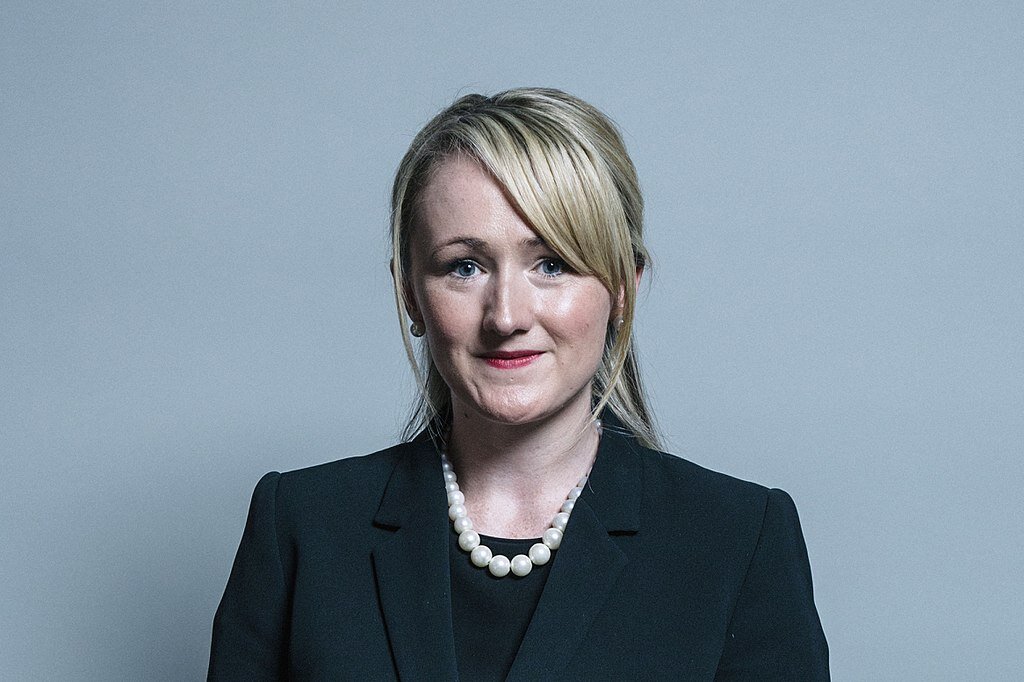
Lewis cites the example of the response to Rebecca Long-Bailey’s use of the phrase “progressive patriotism” in her pitch to be the next Labour leader, and how this was seen by some on the left as dangerously close to racism. Lewis states that “to read so directly across from ‘patriotism’ to ‘racism’ is a fringe position.”

I had criticism of the use of this phrase, but as Lewis said: “Some 67 percent of Britons describe themselves as ‘very’ or ‘slightly’ patriotic. Telling two-thirds of the country that they are secretly racist is a courageous electoral strategy.” I guess my dislike of the idea of progressive patriotism is proof, if anymore where needed, that I’m out or touch with the general voter and live in a bubble.

Personal bubbles

I wonder if this is mainly a by-product of the fact that most of our politics is done online? I don’t get my political news, views and discussion from BBC news bulletins. I get it mainly from the internet, and predominantly from what is served up to me by Twitter and Facebook algorithms.

These algorithms look at the things that I read, the post I interact with and the people I follow to build up a picture of me. They then filter the content that Facebook or Twitter shows to me to reflect my interests: i.e. left-wing politics. This personalisation of content is done to keep my attention focused on Facebook or Twitter for longer so that they can show me more ads, which is how they make their money. 

This all seems harmless until a general election rolls around and I’m left bewildered by the fact that everyone didn’t vote for the party offering more money for schools, hospitals and homelessness prevention, despite the fact that all this was very well received by my Twitter feed.

“The common ground of news”

Adrienne LaFrance said, in an article for Nieman Reports: “The fear that personalization will encourage filter bubbles by narrowing the selection of stories is a valid one, especially considering that the average internet user or news consumer might not even be aware of such efforts.” 

LaFrance interviewed Judith Donath, author of “The Social Machine: Designs for Living Online” and a researcher affiliated with Harvard’s Berkman Klein Center for Internet & Society, who said: “You may have friends or colleagues, and you read the same things in common. You may decide different things about it. Then you debate with those people. If you’re not even seeing the same news story, it leaves you with a much narrower set of people with whom you share that common ground. You’re losing the common ground of news.”

This is what happened to me. Twitter wasn’t showing me the posts from the people who thought that all the nice things that I wanted from a Corbyn government were a waste of money, or posts from the people who wanted to “get Brexit done”, or the people who thought Corbyn was insufficiently patriotic to be Prime Minister. If Twitter had shown me these comments I would have logged off in a sulk and they wouldn’t have been able to show me more ads for hotels in Croatia.

Techno-fixes

There is a technological fix to this, as explained in this Ted Talk on filter bubbles by Eli Pariser. He said that the issue is that Twitter and Facebook give their users an information diet consisting of only things they like, which he calls “information desserts”. However, as any parent knows, it's best to give your children a balanced diet, not just what they like.

Sometimes children need to be given things they don’t want to eat for their own good. I’m referring to us all as children because that’s how the tech platforms treat us and it’s also, frankly, how we act online. According to this idea, it would be good if Twitter showed me some posts of people yelling about how immigrants are stealing the country and we need to vote Tory to stop it, even if I wouldn’t like it.

In principal I’m in favour of this, as long as there's a Daily Express reader somewhere having videos by Hbomberguy dropped into his timeline after he tweets “Get Brexit done” a certain number of times.

Would this work?

I can see the benefit of a varied information diet. According to Pariser it’s a diet of: “Some information vegetables. Some information desserts.” Vegetables, in this case, being people saying that Corbyn is a softy, unpatriotic, metropolitan, immigrant loving liberal and desserts being people saying that maybe the government should do something about all the people sleeping in the bus station every evening.

I’m a little skeptical if this would work. There is lots of evidence that facts (or other people’s opinions) don’t change our minds. Although I am heartened by this story of a young man who fell down a YouTube hole, became alt-right and then changed his views when he encountered left-wing YouTube.

Is this a left-wing problem?

The Facebooks and Twitters of this world might be creating filter bubbles through personalising our timelines, but that’s not specifically a left-wing problem. Everyone is on the internet, even my 69-year-old mum (hi mum, I’ll reply to your email about socks after I’m done writing this).

The accusation of living in a bubble is mainly levelled at the left, specifically the radical left. You don’t see Brexiter, Tory voters being accused of living in a conservative bubble where everyone is frothing about immigrants or Cultural-Marxism destroying Britain. No one says they should be given information vegetables in the form of Owen Jones or Laurie Penny columns.

The views of people who complain about immigrants or metropolitan elites are taken to be common sense. Occasionally, people point out that common sense can be wrong, but that still accepts right-wing views as the default position of most people. I guess if right-wing is the default position then the fact that I disagree means that I do live in a bubble and I’m disconnected from reality.

Centre or right?

Maybe the majority of people in the country are conservative. The evidence for this is a few minutes looking at the supposed “centre ground” of British politics. In January this year, former Liberal Democrat leader Tim Farron wrote an article in the Guardian about what “progressives” need to do to win. In this he said: “At present, Labour’s brand is so terrifying that it pushes voters into Conservative arms.” From reading this you would think that 2019 Labour manifesto includes pledges for a massive war to liberate Palestine, the abolishment of prisons and gender, and confiscating all money above what the average Labour voter earns.

I can see why most people might find that programme a bit too spicy for their bland British sensibilities. However, only the most brain-dead, Daily Mail mainlining, Little Englander would think that’s what a Corbyn government would have been like. Then again, it’s probably what Tim Farron, supposedly in the centre of British politics, thinks a Corbyn government would have been like. Apparently, money for teachers and nurses, helping the homeless, cheaper public transport and green jobs is “terrifying”.

My bubble is my happy place

If you haven’t guessed from my tone so far, I’m not happy with the world outside my bubble. I don’t think most British people are Nigel Farrage, but if this is Tim centre-of-politics Farron’s reality then I don’t want to live in it. So, I’m currently looking at moving to my Twitter feed and I must say that, judging by the pictures, some of these flats in Animal Crossing are very nice.

I don’t know where this leaves the Labour Party. The sad truth is that we do have to win over some people who think that Tim Farron is right and thought Corbyn was so scary that they had to vote Tory. I don’t like saying it, and I’m going to wash my mouth out with soap afterward, but after two defeats for Corbyn I’m starting to think that there aren’t enough craft beer drinkers in Britain to vote in socialism.

That doesn’t mean Labour has to give up on socialism and spend their time chasing some hypothetical centre ground voter. There are stories that can unite the country and break the left out of our Twitter bubbles. Next time I’m going to look into what these are.

Related posts
Jul 28, 2025
Why social media platforms spread the worst political messages
Jul 28, 2025
Jul 28, 2025
Apr 24, 2024
TikTok has many problems, but the hysteria around this app distracts us from the larger problem of unregulated tech companies
Apr 24, 2024
Apr 24, 2024
Prince-Harry.jpg
Jan 17, 2023
Yet another tedious Prince Harry hot take shamelessly written to get clicks
Jan 17, 2023
Jan 17, 2023
Hannah-Arendt.jpg
Dec 20, 2022
Hannah Arendt would be worried about how information technology makes evil more likely
Dec 20, 2022
Dec 20, 2022
George_Orwell_press_photo.jpeg
Jul 31, 2022
How George Orwell predicted our very online political discourse
Jul 31, 2022
Jul 31, 2022
social-media.jpg
May 26, 2020
Does the left live in a bubble?
May 26, 2020
May 26, 2020
Jan 13, 2019
What are the limits to free speech online?
Jan 13, 2019
Jan 13, 2019
nathan-barely.jpg
Dec 23, 2018
Nathan Barley is standing in our light
Dec 23, 2018
Dec 23, 2018
Dec 9, 2018
What would William Morris think of the modern work place?
Dec 9, 2018
Dec 9, 2018
John Bercow.jpg
Oct 21, 2018
The Bercow scandal shows that Remain fake news is a problem
Oct 21, 2018
Oct 21, 2018
May 26, 2020 /Alastair J R Ball
The crisis in Labour, Technology, Political narratives
Comment
Labour Party.jpg

The Labour needs an effective story to start winning again

May 12, 2020 by Alastair J R Ball in Political narratives, The crisis in Labour

In the last four British elections whatever the Labour Party was selling, the UK wasn’t buying. Be it centrist Gordon Brown, soft-left Ed Miliband or radical left Jeremy Corbyn, the British electorate wasn’t interested.

Whatever Labour tries it doesn’t work. They have policies, media plans, electoral strategies, but it doesn’t all come together. There’s been something crucial lacking: a story. A story that Labour can tell that ties up all their ideas and policies into a vision for the future that the voters can get behind.

Both Miliband and Corbyn tried to tell stories about where the country had gone wrong under Tory rule, but these failed to capture the public’s imagination. Both had popular policies, but the story that united them into a vision was lacking. Now that Labour has a new leader, Keir Starmer, the party needs to think about the story it’s going to tell.

Where stories are needed

A good place to start looking for a new story is the two debates of the last few years where Labour’s lack of an effective story has had the most severe impact: Brexit in England and Independence in Scotland.

Brexit and Scottish Independence have been a pox on Labour’s house. They cut across Labour’s voting coalition and have divided the party. This is because the stories that are being told on either side of these great divides don’t mesh with the stories that Labour is telling. The stories of Brexit and Scottish Independence concern national identity, a subject that Labour is not comfortable telling stories about. Labour is much more comfortable telling stories about class or social justice than national identity.

Stories and national identity

National identity is the story of the nation itself. The story of the USA is that it was created in a revolution to give its citizens life, liberty and the pursuit of happiness. What actually happened in American history is something else, but that doesn’t stop the story of America being a great story. One that has made America, for better or worse, the world’s flagship democracy. This story is deeply embedded in American culture, seen in media as diverse as The West Wing and An American Tale.

Other countries have stories bound up in their nation’s identity. The story of Israel is that it’s the promised land of the Jewish people as laid out in the Tora and the Old Testament and that after the Holocaust, it’s the only place where Jews can be safe. Britain and Scotland have stories behind their national identity too, which I’ll come back to.

Stories of national identity and political campaigns

The story a political party or movement is telling to win over voters needs to work with the story of the nation. Brexit works well as a political story. It’s the story that says: the country is being stolen from the good, honest citizens by a nefarious elite for their own enrichment. Again, whether it’s true or not is immaterial. It’s a great story, which people believe, and it inspires them to vote a certain way.

The story that Scottish Independence is telling is that Scotland is held back, or ground down, by being a part of Great Britain. You can interpret this story in a number of ways. You can believe that Britain is too conservative, or that Britain wants to keep Scotland at heel out of spite, or any other reason why attaching Scotland to Britain (mainly England) is bad for Scotland. What’s important is that the story tells of how much better Scotland would be if it were an independent country.

You can argue about the evidence to back up this story, which is that the independence campaign was on one level. However, it is undeniably a compelling story about Scotland that motivates people to vote for independence.

Political campaigns and counter narratives

Political campaigns are stories. Remain and Leave are both stories about Britain. Yes or No to independence are stories about Scotland. For a story to win an election there are two things to avoid.

The first is the counter-narrative to your campaign’s story that can neutralise it. For the Scottish Independence, it was a story of how much better Scotland is off in the union. The story is about the money that comes to Scotland for being part of the world’s fifth largest economy. The Scottish Tories push this counter-narrative the most. Scottish Labour has struggled to tell this story as many Labour activists don’t want to be telling the same story as the Conservatives.

Contradictions to political stories

The second factor that can cause the narrative of a political campaign to become unstuck is anything that can contradict the story that you are telling. For Scottish Independence this was anything that showed that Scotland was not a viable nation outside Britain, such as disputes on whether an independent Scotland could use the Pound or could produce its own currency.

These contradictions can be more damaging than an effective counter-narrative as they lead voters to stop believing in your story. This is why the Scottish Independence referendum became an argument over the facts that support the independence story, because if they didn’t and instead contradicted the story, then the story loses its power.

Lessons from the Scottish Independence campaign

Labour got what it wanted out of the 2014 Scottish Independence referendum because of the interplay of these two factors. The story of Scottish Independence had too many contradictions. Boring stuff such as currency arrangements undermined the story the pro-Scottish Independence side was telling.

At the same time, Gordon Brown was able to lay out the counter-narrative. He was the only British politician who could tell this counter-narrative without adding to an element of the pro-independence narrative that all British political parties are the same in wanting to keep Scotland shackled to Britain.

These two factors coming together may not happen again. If Labour are committed to keeping Scotland in the Union, then they need to come up with their own counter-narrative to that of independence. The only alternative is to use the same counter-narrative as the Scottish Tories, which only fuels the independence narrative.

The left and stories of national identity

The counter-narrative to Scottish Independence that Labour need to develop (to either win seats in Scotland again or prevent Scotland leaving the Union) needs to factor in Scottish national identity. Labour also needs a story about British (or maybe English) national identity. Labour have no effective counter-narrative to Brexit and no way of contradicting the story of Brexit, which is why Brexit won the 2016 referendum and has divided Labour’s electoral coalition since.

Labour (or the left more broadly) need to tell a story about British national identity if we’re going to start winning again. Tony Blair, for all his faults, was able to tell a story about how Britain was casting off the shackles of the past 18 years. No longer will crusty old Tories be in charge. Britain was becoming a young, energetic, dynamic nation. It helped that Brit Pop and ‘Cool Britainnia’ was happening at the same time.

Critiques of stories about national identity

On the left, we have many critiques of the story of Britain. We’re good at pointing out how the British Empire was founded on imperialism, racism and exploitation. We’re also good at saying that nostalgia for a past that didn’t exist as we collectively remember it is holding us back from tackling the challenges of the 21st century.

Now don’t get me wrong. These critiques are important. They can be used to contradict political narratives or build counter-narratives. They are also important in recognising that reality is more complicated than a story, which mustn’t be lost sight of. However, the left needs to tell a story about national identity that is different to that of the populist right, or stories about national identity will be used as a weapon against us.

The left is uncomfortable about telling stories about national identity

The left feels uncomfortable about telling stories about national identity. We prefer stories about groups of people and not nations. Stories about groups of people (bound by class, region, culture, race, religion, sexuality identity, age or anything else) are important and should not be neglected. Again, they will inform the counter-narrative to the populist right that must be laid out.

Nations are made up of groups of people and we need to find a story that means all the people of Britain can live together. Most people in Britain identify with the nation and its story, not just the disaffected white old people who voted for Brexit, so the left needs to find a way to tell a story about national identity.

Labour needs to find its story

When faced with the narrative of Brexit, Labour wasn’t part of the counter-narrative - that Brexit is a bad idea and that it’s good to be in the EU - and Labour were unable to contradict the Brexit narrative. However, Labour were not telling the Brexit story and thus the Tories were able to use this story - that disconnected politicians were trying to thwart the will of the people - to convince over enough voters to win the 2019 general election.

The problem that faced Labour was that the stories of Brexit and Scottish Independence split the Labour coalition. Labour was unable to choose a side between the narrative and counter-narrative for either, and have been caught in the middle of it.

Labour doesn’t need to tell the Brexit story, but it does need to find a way to contradict it or lay out a counter-narrative to start winning again. The same is true for Scottish Independence. Contradicting a story about something as nebulous as the future of a nation is difficult, so Labour need a counter-narrative. This counter-narrative will have to involve a story about national identity.

Brexit has happened and a second Scottish Independence referendum looks unlikely during the coronavirus outbreak, but Labour still lacks a story they can tell to convince the voters to buy what Labour is selling. A story about national identity. Unless Keir Starmer can come up with an effective story that includes British and Scottish national identity then he too will lose elections as his three predecessors did.

Labour Party picture taken by Andrew Skudder and used under creative commons.

Related posts
Keir_Starmer.jpg
Sep 30, 2021
Where is Labour going?
Sep 30, 2021
Sep 30, 2021
High-Conflict-Amanda-Ripley.jpg
Aug 17, 2021
The civil war in Labour has become a High Conflict. How do we get out of it?
Aug 17, 2021
Aug 17, 2021
Union-Jack.jpg
Jun 15, 2021
I don’t feel patriotic, but Labour needs to appeal to more than just people like me
Jun 15, 2021
Jun 15, 2021
polling-station.jpg
May 10, 2021
Labour can be the party for Walthamstow and Workington, but it needs a vision first
May 10, 2021
May 10, 2021
polling-station.jpg
Apr 16, 2021
How Labour lost the working-class
Apr 16, 2021
Apr 16, 2021
Labour Party.jpg
Jul 20, 2020
The Fall of the Red Wall by Steve Rayson shows the role that narrative played in Labour’s defeat
Jul 20, 2020
Jul 20, 2020
social-media.jpg
May 26, 2020
Does the left live in a bubble?
May 26, 2020
May 26, 2020
Labour Party.jpg
May 12, 2020
The Labour needs an effective story to start winning again
May 12, 2020
May 12, 2020
Scotland-flag.jpg
Apr 14, 2020
Labour is trapped by the split over Scottish independence in Scotland and England
Apr 14, 2020
Apr 14, 2020
Rebecca_Long_Bailey.jpg
Mar 31, 2020
Who should be the next Labour leader?
Mar 31, 2020
Mar 31, 2020
May 12, 2020 /Alastair J R Ball
Political narratives, The crisis in Labour
Comment
Scotland-flag.jpg

Labour is trapped by the split over Scottish independence in Scotland and England

April 14, 2020 by Alastair J R Ball in The crisis in Labour

The further North one travels the harder it is for Labour to win. London is a Labour stronghold, but in the last election the Tories won across large swathes of the Midlands and the North. Travel north of England and you get to a land where Labour haven’t won a decent share of the seats since the 2010 general election.

Labour lost badly in Scotland in last year’s general election. However, Labour’s problems there pre-date Jeremy Corbyn’s term as leader. The problem goes back to Labour standing shoulder to shoulder with the Tories in the 2014 Scottish Independence referendum and how Labour dealt with the rise of the SNP in Holyrood before that. In the 2010 general election, Labour won 41 seats in Scotland the SNP won six. In 2015 the SNP won 56 seats to Labour’s one. Since then, Scotland has been beyond Labour’s reach.

The problems Labour is facing in its former heartlands are worse in Scotland and the factors that led to Labour’s woes have been fermenting north of the border for longer. Last December Kirkcaldy and Cowdenbeath, the seat of former Prime Minister Gordon Brown where Labour once boasted a majority of 23,009, was won by a SNP nominated candidate. (Although candidate Neale Hanvey was suspended from the SNP for alleged anti-semitic social media posts.)

In Holyrood, and in Scottish seats in Westminster, the SNP rule supreme. Will Labour ever be able to win in Scotland again? Can they stop the all-defeating Scottish National Party?

 The success of the SNP 

The SNP’s success is partly due to their effectiveness as a political party. Whilst I am personally opposed to all forms of nationalism, from angry Trump nationalism to softly spoken SNP nationalism, I must acknowledge that Nicola Sturgeon is a very talented politician and a great leader for the SNP. She combines a wild passion for change with a calm reasonableness that allows her to not only bridge, but to transcend, the gap between idealistic and pragmatic politics.

The SNP are able to present themselves as lefty (or at least liberal) in contrast to the underlying conservatism of the English and thus appeal to left-wing Scotts who are tired of being ruled over by right-wing governments they didn’t vote for. At the same time, they are appealing to the voters moved by nationalism: a politics of identity based on place of birth and a sense of grievance that the people born in said place have been betrayed by a culturally (and physically) distant elite.

The SNP are also in power in Holyrood and using the authority of being in government to increase their support, as all governments attempt to do. At the same time they are telling a story about how Scotland can be a radically different country, if the SNP are allowed to follow their transformative agenda. They are both technocrats and populists; passionate and pragmatic. They’re something to everyone, or at least most Scots.

Anti-English hatred

The SNP benefits from an underlying current of anti-Englishness in Scotland that can spill over into outright hatred. The SNP themselves aren’t frothing with hatred like many nationalists the world over, but they do benefit from being the electoral home of anti-English hatred. This allows them to appear moderate and reasonable whilst winning the support of people who are very angry about the status quo.

There isn’t a party more nationalist than the SNP in Scotland. No one is biting at their flank, accusing them of being too moderate and peeling off the more hardcore (or more angry) proponents of Scottish nationalism. This allows the SNP to reach out to undecided Scotts, the wavering people who could decide the outcome of a future independence vote. 

These voters are a crucial part of the SNP coalition and they depend on them for their victories in Westminster and Holyrood elections. The SNP don’t have the risk of being the victims of a rear-guard action. I do wonder how they would manage their message, if they had a more aggressive, openly hateful of the English, nationalist rival to contend with.

Labour is caught between union and independence

The SNP’s strength is that they can tailor their message to appeal to the crucial swing voters in Scotland, safe in the knowledge that committed nationalists are behind them. Whereas Scottish Labour is trapped between supporters of independence and supporters of the union, just as Labour is caught between Leave and Remain voters. 

Labour is not seen as sufficiently pro or anti-Scottish independence. The parties that have done well in Scotland have a clear position: the SNP for independence and the Scottish Tories (once on the verge of extinction) for the union. Despite Labour moving to the left, they are still stuck in the middle of a political divide.

Emotive issues

This is splitting the Labour vote is causing electoral ruin. The independence/union fault runs across the middle of the Labour voting coalition, just as the Leave/Remain faultline does. In England and Wales, the Tories revived their fortunes after the disastrous 2019 European elections by unambiguously choosing a side of the divide and leveraging it for all it was worth.

Scottish independence (or Brexit) are very emotive issues. They concern how people see the future of their country. On such emotive issues, voters response well to passion and not moderation. This isn’t the 90s, where being dispassionate and shunning ideology was the way to show you were serious about politics.

This is an age of emotive stories about what the future should be like and Labour is losing out by not having a firm stance on the most important issue affecting Scotland. For Scottish independence (and Brexit) Labour needs to find the side it feels passionate about and strongly articulate this to the voters. 

Angry English Brexiteers 

The issue of Scottish independence is not only divisive in Scotland, but in England as well. If Scotland were to leave the union, it would be a radical change to the United Kingdom. In many ways the country would cease to exist and we would become a new country. Thus English people’s views on Scottish independence is tied up with other highly emotive political debates that concern how we see the future of the country. 

From speaking to English people about Scottish independence the split of opinion (roughly) follows the same divide as English people’s views on Brexit. However, not in the way that you would think. Remainers tend to be more pro-Scottish Independence and Brexiteers more pro-union. Being able to leave pan-national political unions it appears, doesn’t extend to the Scots.

English Brexiteers really don’t like the SNP. Not all of them feel this way, but for many a Brexiteer mentioning the SNP gets their blood up faster than calling the British Empire a racist project or criticizing nostalgia for the Blitz Spirit. The root of this objection to the SNP is that they are seen as anti-patriotic. Their fundamental political goal is the destruction of the United Kingdom, or least it's irrevocable change, which is antithetical to the English.

Anger about the Barnett Formula

In addition to this, the SNP exists to campaign for Scotland. They’re seen as wanting to get more than Scotland’s fair share, and there’s nothing that makes an English person angry than the thought of someone, who isn’t them, (maybe, gosh, someone who is different to them) getting more than their fair share).

This is tied up in anger about the Barnett Formula and how public money is allocated to Scotland. The Barnett Formula seems quite reasonable to me (it will obviously cost more to run an ambulance service in the Scottish Highlands than in East London) however, many English people see the SNP’s advocating for Scotland as nothing but naked greed at the expense of English taxpayers. 

English Remainers and pro-EU Scottish nationalists 

English Remainers are different. They’re generally more in favour of Scottish independence and some are even more vocally pro-SNP. I have seen some Labour supporting English Remainers praising the SNP when Labour make noises about accepting the referendum result and listening to Labour supporters who voted for it. This is usually tied up with English Remainers claiming they are politically homeless.

The SNP have won affection from English Remainers by doing the two things they want most from English political parties: being pro-EU and winning. The SNP does this well and no English political party can muster both.

My view 

I’m an Englishman (anyone who has heard my ridiculous RP accent will know I am incurably English). I was born in the Midlands and live in London. However, my family has roots in Scotland, something that was acknowledged by giving me the Scottish name Alastair. As such I have fondness for Scotland as part of the United Kingdom that goes beyond what I feel for other regions, even my native Midlands.

Personally, I am opposed to Scottish independence. I see any form of nationalism as stoking the fires of strife between people. I feel no strong national identity or attachment to the nation state. I don’t want to make more nations, but less of them. I want to see humanity united in a common union of us all, although I’m not sure what this would look like as a political project.

Also, if Brexit has taught us anything, it’s that unwinding political unions along a timeline that satisfies voters hungry for immediate change is a waste of time that could be better spent doing anything else. Like more Olympics and Eurovisions, everyone loves those.

England divided

It’s my strong belief as an Englishman that the issue of Scottish independence says something about how we see ourselves and our country. On one side we have those who believe that your national identity, as determined by where you were born, is important and want these national identities to be protected. Protecting national identity includes taking Britain out of the EU, but keeping the United Kingdom together. It also includes limiting immigration and preserving British culture as it is. 

On the other side we have those who are skeptical of national identity and value political projects that transcend nations. They believe that national cultures are enhanced by the mixing of people and the changes this brings. Their belief in this includes supporting parties whose purpose is tearing up existing nation states, so long as they preserve the overall goal of maintaining the political projects that transcend nations.

The way forwards

If Labour is going to form a majority government ever again then it needs to be able to win in Scotland. Now that Labour has a new leader, Keir Starmer must make winning back Scotland a priority if he is serious about winning power in Westminster. Labour needs a position on Scottish independence that shows passion and that speaks to Scots. Half measures will not be enough. 

Labour’s problem in Scotland speaks to a bigger problem facing Labour across the entire United Kingdom. The problem is that Labour don’t have a story they can tell that speaks to people across the country, a story that makes the voters desire a Labour government. This story needs to include Scottish identity and go beyond it to include all national identity. How can Labour tell such a story? That’s what I will dive into next time.

Related posts
Keir_Starmer.jpg
Sep 30, 2021
Where is Labour going?
Sep 30, 2021
Sep 30, 2021
High-Conflict-Amanda-Ripley.jpg
Aug 17, 2021
The civil war in Labour has become a High Conflict. How do we get out of it?
Aug 17, 2021
Aug 17, 2021
Union-Jack.jpg
Jun 15, 2021
I don’t feel patriotic, but Labour needs to appeal to more than just people like me
Jun 15, 2021
Jun 15, 2021
polling-station.jpg
May 10, 2021
Labour can be the party for Walthamstow and Workington, but it needs a vision first
May 10, 2021
May 10, 2021
polling-station.jpg
Apr 16, 2021
How Labour lost the working-class
Apr 16, 2021
Apr 16, 2021
Labour Party.jpg
Jul 20, 2020
The Fall of the Red Wall by Steve Rayson shows the role that narrative played in Labour’s defeat
Jul 20, 2020
Jul 20, 2020
social-media.jpg
May 26, 2020
Does the left live in a bubble?
May 26, 2020
May 26, 2020
Labour Party.jpg
May 12, 2020
The Labour needs an effective story to start winning again
May 12, 2020
May 12, 2020
Scotland-flag.jpg
Apr 14, 2020
Labour is trapped by the split over Scottish independence in Scotland and England
Apr 14, 2020
Apr 14, 2020
Rebecca_Long_Bailey.jpg
Mar 31, 2020
Who should be the next Labour leader?
Mar 31, 2020
Mar 31, 2020
April 14, 2020 /Alastair J R Ball
The crisis in Labour
Comment
Richard-Dawkins.jpg

Truth, stories and pain: how do we know what is real?

April 01, 2020 by Alastair J R Ball in Political narratives

This is a story that is made up of other stories. Many long stories are smaller stories pieced together. Star Wars is made up of the story of two droids escaping Tatooine, then the story of the heroes surviving inside the Death Star and finally the story of the battlestation’s destruction. Similarly, the news is the story of our civilization told through smaller stories about power cuts or votes in parliament.

This story begins not long after I finished university, when I was caught in the nether world of recent-graduate unemployment. I paraphrase Ronan Harris of Futurepop group VNV Nation: I was so far from the shores of studenthood I had left behind, still far from the shores of employment I had yet to reach. I got very good at playing Worms United on an old PS1 that I found in the basement.

At the time I was an angry young man and the focus of my anger was religion. I had recently read Richard Dawkins’s The God Delusion and was fired up to tell all religious people, of whatever faith, that they were wrong and that they needed to embrace the objective truth of science. Preferably through watching Richard Dawkins documentaries on DVD, which I owned quite a lot of. I know now that this attitude of superiority and rudeness to people who think differently is not helpful. I am still very much an atheist, but I do not feel the need to declare this to everyone I meet.

At the time, there was a story I told myself about who I was. The story was simple: through my life and learning I had come to see the truth of the universe: there was no bearded man in the sky who had made everything, no paternalistic father figure or jealous supernatural tyrant watching over us. I believed that the material world was all there was; no spirits or ghosts or angels or demons. My life via Scout Group church services and internet atheist forums had brought me to an understanding of this fundamental truth of the universe. It was a story that was incredibly important to me. The story was me.

Then I moved in with a group of former students in the same position as me. A group that included a High Anglican, who was considering a career in the priesthood of the Church of England, a Roman Catholic and a man who followed a diverse pantheon of gods and other supernatural beings drawn from a variety of faiths that included Buddha, nature spirits and the Norse god Loki, amongst others.

There is a finite number of hours that bored adults can play Worms United for, and so eventually we started arguing. A lot. About everything. Gradually, and through many shouting matches, something dawned on me. They were as smart as I was, probably smarter. There was not a veil of ignorance protecting their worldview that I needed to puncture. Not only that, but they had stories about their lives that had led them to be the people they were, just as I did.

This led me to think: who is the arbiter of objective truth? How do we know what is true and what is not?

In their book Factfulness: Ten Reasons We're Wrong About the World – And Why Things Are Better Than You Think, Dr Hans Rolsing, Ola Rosling and Anna Rosling Rönnlund laid out ten simple methods of defining the truth. Their tips (such as avoiding comparing extremes, remembering that things can be bad and getting better, avoiding lonely numbers and avoiding single perspectives) are useful for not being misled by eye-catching dramatic headlines, but they do not help tackle questions such as “is God real?”

Dr Rosling et al’s Factfulness ties in with post-enlightenment thinking, which claims that truth can be found in the scientific method. This appealed to me as an atheist, but the question of the existence or non-existence of God remains impervious to scientific investigation. We are no closer to a definitive answer to the question than the enlightenment thinkers were.

Technology companies claim that they have found the truth of humanity through big data. All the information gathered through our devices betrays the truth of who we are. We are more ourselves when we are alone with our phones then we are with anyone else. Big data reveals preferences and patterns of behaviour that even the most probing focus group cannot uncover. However, big data may reveal truths about human behaviour, but not about the universe.

I could not prove objectively that I was right, and that God or Loki did not exist. I did not stop being an atheist, and I still am. However, I came to see the story of my life not as a journey towards discovering a fundamental truth about the universe, but as a story of finding my truth about the universe, which was one amongst many. It was the only way to get along in a small house with no jobs, no money and little to do.

The story of my first post-university houseshare is now key to how I see myself. It includes the story that made me a hardcore Dawkins-esque atheist, but it also includes other important lessons about life such as the benefits of personal growth, the value of re-examining your thinking and the importance of friendship. This is a better story.

As well as my opinions about atheism, I have deeply held political views about the importance of being tolerant towards other people of different races, religions, sexualities, gender identities, subcultures and interests. I believe it is important to be respectful of other people and their personal stories.

The story of my post-university houseshare fitted into this. It was a story about how I was open-minded and receptive to a plurality of views and lifestyles. We cannot be certain that God did or did not cause the Big Bang, even though I believe he did not (or at least we cannot be as certain about the origins of everything as I am about the fact that the table I am leaning on exists). This also applies to the question of whether Loki is real or how tangible the spirit of Mother Nature is. I have my own beliefs, but I do not have a direct line to the objective truth of the universe. As we cannot know if our beliefs are the objective truth, it is important to be open to new ideas and to seeing the world from other people’s point of view.

There was another story that I told myself that factored into this. It was about all of history and how it could be expressed as the story the powerful trying to exploit the weak and the weak crying out in anger and frustration. This cry of frustration has echoed through time and could be felt in Moses’s demand of the Pharaoh to “let my people go,” through medieval peasant uprisings, the Levellers, Peterloo, the Suffragettes, the Civil Rights Movement, the Stonewall riots and all the way to anti-austerity protest movements. This cry of pain was captured in the works of Harriet Jacobs, James Baldwin, Robert Tressell, Pablo Picasso, Laurie Penny, the Selford Mods and many others. This was a single story of the shout of defiance in the face of oppression that had sounded throughout all of human history. 

In the last few years this story of being tolerant to a plurality of different views and life stories has come under attack. There are those who do not want to listen to the voices that throughout history have cried out in pain as they were clamped down on. The voices of women, people of colour, LGBTQ+ people, poor people and people who did not fit into the limited range of pre-set sockets that their society had provided.

Being a tolerant person was part of the story of who I am, but I also agree with Karl Popper that: "In order to maintain a tolerant society, the society must be intolerant of intolerance." Attacks on tolerance have come from internet trolls who wish to silence women who speak out in the #MeToo movement and social media hate preachers who to vent their anger at people of colour who demand basic safety and bodily autonomy.

Some of those who attack tolerance are in groups with names such as GamerGate, the Proud Boys, Incels, the alt-right or neo-Nazis. There are too many to name here and we are all too painfully familiar with the forces of intolerance. There is no general name for them all that I could use in this polite essay, so I will refer to them as the “forces of intolerance”.

Members of the forces of intolerance have two things in common. Firstly, they reject the story of history as a cry of pain from the oppressed and in doing so reject the stories of many people throughout history who have suffered at the hands of the powerful. They seek to recast themselves (they are usually white, straight men) as the real oppressed people of history, and thus they reject any understanding of political power throughout history that I recognise.

Secondly, they believe that their actions are supported by objective truths about the universe. This I find very frightening. They have no time for the opinions of others or other people’s stories. It is no coincidence that thinkers championed by the forces of intolerance, such as Jordan Peterson, are so critical of postmodernism, as postmodern ideas about there being no objective facts threaten their certainty.

When I see Ben Shapiro claim that “the facts don’t care about your feelings” and then making an emotionally-charged, subjective statement which he passes off as fact, I remember the story of my life. A story that tells me that I used to believe that certainty was on my side until I met other people who were equally certain and so learned a valuable lesson. This was a painful, frightening lesson to learn, but it was worth it to be more open-minded to the experience of others.

The forces of intolerance have not learned this lesson. They believe they are irrefutably correct. However, they have no more claim to objective reality than my former housemate who had a shrine to Loki in his bedroom.

Where does their claim to objective truth come from? It comes from stories they tell with which a lot of people, sadly, have sympathy. Narratives play a bigger role in what we think is true than ‘Factfullness’, the scientific method or big data. In his radio show The Tyranny of Story, John Harris lays out how narratives are more effective in politics than facts. He shows how Donald Trump’s story about the dangers of vaccinations was much more effective in convincing people on the campaign trail than former neurosurgeon Ben Carson’s calm facts about vaccines.

Does what you believe to be true fit into a larger narrative? Does your story tie in with a bigger story like “Take Back Control”, “For The Many Not The Few” or “Make America Great Again”? If what you tell yourself about who you are fits into one of these larger narratives, then you are more likely to think your truth is the truth.

There are many of these larger narratives and they conflict with each other. Just because I can make my personal narrative fit with “For The Many And Not The Few” does not mean someone else cannot make their narrative fit with “Take Back Control”. We all have stories, so authenticity becomes important in judging what we believe to be true.

Cambridge academic David Runciman describes this in his book How Democracy Ends as an affirmation with authentic truth-tellers. We see these people as the ones who call out the fake narratives and reaffirm the authentic ones, i.e. the ones that chime with our own personal narratives. These people can be Chelsea Manning or Tommy Robinson.

Technology also contributes to a sense of certainty. We live our lives online, tell stories about our weekend on Instagram, our careers on LinkedIn, read stories about other people on Facebook and wider society on Twitter. There are millions (and in the case of Facebook billions) of people using these platforms, which means there is too much information and it would be too disorganised for us to see all of it. All of these platforms are gathering data about us and use this to customise what we see.

What I see when I log into Facebook or Twitter is different from what you will see. On some level it is an expression of my story as represented by data points and then fed back to me as content. A news story that fits with my personal narratives, and the larger narratives about society that a technology platform knows I subscribe to, will be more significant in my circle of digital friends than it will be for someone whose data points or personal narrative is different.

This process of personalisation of internet content is dividing us into different camps, and fundamental truths can vary massively between these camps. All of this is fed by the data that technology platforms have, which we gave as we expressed our personal stories through them.

This is what allows the forces of intolerance to claim that they see the world objectively. Their message is funnelled by technology platforms towards people who are likely to see the world as they do. They do not encounter opposing views, as I did in my first post-university houseshare.

Narratives will spread amongst people in these camps and take on the appearance of objective fact, just as Harris described for Trump’s comments about vaccinations. Some of these camps can be large, with names like liberal or conservative. Some of them can be small, but the effect of a story taking on the appearance of objective truth is the same.

This process is best illustrated by the story of the “Johnlock” fandom, a subset of the fans of the BBC TV show Sherlock who believe that there was a romantic connection between the characters of Sherlock Holmes and John Watson. Whether or not Holmes and Watson are secretly in love with each other cannot be proven objectively, but a story about the future of the TV show can take on the appearance of objective fact.

There is a sub-group of the Johnlock fandom called TJLC (The JohnLock Conspiracy) who believed that Holmes and Watson would become a couple at the end of the fourth series of the show and that its creators, Steven Moffat and Mark Gatiss, were hiding elaborate clues to this fact in the show.

Like any other group through which a narrative spreads and takes on the appearance of fact, TJLC is a community and its members put together elaborate explanations of why they were right. This included a 48-part YouTube series which asserted that Holmes and Watson would become a couple in the final episode of the fourth series. The final of the 48 videos claimed "it's about to happen", stating that Holmes and Watson will become a couple as a fact.

To the members of TJLC their belief was true - completely and irrevocably an objective truth. The story that they spread through the TJLC took on the appearance of objective fact, helped along by pieces of evidence such as the showrunners’ love of playing games with the fans and misdirecting them. Despite this, it was not revealed that Watson and Holmes were a couple in the final series of the BBC detective drama. The views of TJLC were revealed to be subjective opinions about where the show was heading.

Slate TV’s critic, Willa Paskin, interviewed members of TJLC for her podcast Decoder Ring, whose research I drew on heavily. When interviewing the progenitor of TJLC, who still asserts as fact that Watson and Sherlock will become a couple, Paskin states that she is becoming convinced of this fact despite the fact that there are currently no plans to make any more series of Sherlock. In the podcast Paskin said: “there is something compelling about being in the presence of so much passionate certainty."

The certainty with which TJLC asserted their subjective view of the reality of the Sherlock TV show led me to believe that everyone sees the world subjectively, based on their own personal story, the narratives about wider society they subscribe to, the personalised information environment they get from social media, and the community bubble they live in  made up of their friends, family and other people who are likely to be similar to them. Within our own subjective lives there are things that are objective truth to us, but they are all in reality subjective. We all live subjective lives.

Fake news is a part of this. It reflects the subjective lives people live and the fact that they think their subjective truth is an objective truth. “Pope Endorses Trump”? This is an objective truth to the people who support Trump and shared this fake news story on Facebook. To them, how can the Pope not support Trump? How can this not be true?

The forces of intolerance do not see their subjective view of reality as subjective. They see it as objective reality, just as members of TJLC did. This inability to see other people’s subjective truths as having validity equal to theirs is one reason why they cause so much pain. 

In their minds, it is an objective truth that saying racist, sexist or homophobic things is acceptable. In their minds, the symbols of the Confederate flag or Nazi swastika represent an objective truth about the universe that everyone else does not understand. They are wrong, but this does not stop them from causing lots of emotional and physical pain. I am writing on the two-year anniversary of Heather Heyer being killed by neo-Nazi James Alex Fields Jr at the “Unite the Right” rally in Charlottesville, Virginia. This showed how dangerous people can become when they believe they have objective truth on their side.

There are many other subjective narratives that cause pain. In some people’s minds it is an objective fact that vaccines have a risk of causing autism. This narrative causes real pain for children who catch the diseases for which vaccines are available. It also causes pain for the people who cannot get vaccinated and so rely on herd immunity to keep them safe.

Narratives that deny climate science or seek to minimise the threat posed by the climate emergency also run the risk of causing real pain when communities are destroyed by rising sea levels. A subjective truth backed up by a story has a huge amount of power to hurt people.

There was a story I told myself about the world not having an objective truth in it. This story helped me understand the person who I was. However, I had to outgrow it to live with other people and to understand that they had their own story informed by different ideas, different personal experiences and different facets of the world. This allowed me to understand that the world is made up of subjective truths which might appear objective, but are not.

The world is made up of subjective truths, but this should not minimise the pain that these truths can cause. Pain is real and it is the only universal truth, so we must do what we can to minimise it, and even if we don’t understand someone’s pain we should do what we can to help them. The forces of intolerance do not see the pain that their narratives bring, and therefore their narratives must be opposed.

This is a story about how we can live together by recognising the subjectivity of each other. However, we can’t live together if it means that our own subjective truths lead us to inflict pain on each other. We must learn there is no objective truth and we must learn not to hurt each other.

"Richard Dawkins no Fronteiras do Pensamento Porto Alegre" by fronteirasweb is licensed under CC BY-SA 2.0

Related posts
Sep 16, 2025
The right finally discovers that life sucks for Millennials, but guess who they still blame
Sep 16, 2025
Sep 16, 2025
Union-Jack.jpg
Aug 20, 2025
Who really holds power? The cultural illusion of middle-class dominance
Aug 20, 2025
Aug 20, 2025
Apr 12, 2025
How should the left view the porn industry?
Apr 12, 2025
Apr 12, 2025
Books.jpg
Mar 28, 2025
Behold the smartest people in the room: The Waterstones Dads
Mar 28, 2025
Mar 28, 2025
Feb 18, 2025
Russell Brand isn’t the only person on the hippy to alt-right pipeline and the left should be aware of this
Feb 18, 2025
Feb 18, 2025
polling-station.jpg
Dec 3, 2024
Steve Rayson’s Collapse of the Conservatives shows how Labour benefited from voters’ volatility but may also suffer from it
Dec 3, 2024
Dec 3, 2024
nigel farage.jpg
Aug 13, 2024
The rhetoric from mainstream politicians on migration caused these riots
Aug 13, 2024
Aug 13, 2024
IMG_4111.JPG
Mar 19, 2024
The discourse around extremism is based on hand waving at best and Islamophobia at worst
Mar 19, 2024
Mar 19, 2024
Tony-Blair.jpg
Sep 26, 2023
What does Tony! [The Tony Blair Rock Opera] tell us about how the Blair era is remembered?
Sep 26, 2023
Sep 26, 2023
8644221853_6af3ffe732_c.jpg
Aug 22, 2023
The cost of living crisis isn’t recent and has deep roots in the economy
Aug 22, 2023
Aug 22, 2023
April 01, 2020 /Alastair J R Ball
Essays
Political narratives
Comment
Rebecca_Long_Bailey.jpg

Who should be the next Labour leader?

March 31, 2020 by Alastair J R Ball in The crisis in Labour

This Labour leadership race feels like it has been going on forever. I mean, when this race began, we could go outside, and now we can’t. Life comes at you fast, as they say. 

However, this weekend it will finally end. On Saturday a new Labour leader will be announced via an online video, I believe, to maintain social distancing. Then, finally, the race that began when Labour lost the general election in December will be over. There’s just one last thing for me to do: vote for the candidate I want to be Labour leader.

I’m optimistic about a Labour Party led by any of these candidates. Of the three candidates still in the race, I don’t think any of them would be a terrible leader. They would all bring something interesting to the role.

Conversely, there is no candidate that has really impressed me. None of them have seized this race as an opportunity to show that they embody the future of the Labour Party. No one has transcended this race and captured the interest of the general public.

I don’t feel as confident casting my vote today as I did when voting Jeremy Corbyn in 2015. I guess, this means that whoever wins has the opportunity to rise above my expectations and become a greater Labour leader.

So, without further ado here are the candidates in the order in which I voted for them:

Number 1: Rebecca Long-Bailey

I decided to put Rebecca Long-Bailey first mainly because of her work on Labour’s Green New Deal, an excellent piece of policy-making that is exactly what the country needs. It may sound silly to say that the looming environmental catastrophe is the biggest challenge facing the country during an outbreak of a deadly disease, but I have every confidence that Covid-19 will subside and the current state of emergency will end. The damage being done to the environment is permanent and it threatens many more lives than coronavirus. There isn’t going to be a vaccine against rising sea levels. Well, apart from being rich.

Long-Bailey has been a tireless campaigner for the things I want most from a Labour government from a Universal Basic Income to enhanced workers’ rights. She is a confident media performer, able to handle a tough interview, as she has shown during the Corbyn leadership. I have great confidence that Long-Bailey would be a capable Labour leader.

Number 2: Keir Starmer 

It was a difficult decision as to who I was going to put second on my list of preferences. What convinced me to put Keir Starmer second was his 10 pledges. Let’s be honest, Starmer has been the front runner in this contest since quite early on, and he’s very likely to win it. He could have coasted to victory saying little and making few commitments to what his time as leader would be like. However, he didn’t do that. He unveiled 10 decent, left wing pledges that are all things I agree with, from social justice to devolution. Although his pledge on the environment falls short of a commitment to a Green New Deal, Starmer is promising action on this key issue. 

Starmer was director of public prosecutions and in that time showed that he cares deeply about human rights and protecting the vulnerable. These are the qualities we want from a new Labour leader. Starmer’s political instincts may be closer to Ed Miliband than to Corbyn, and it’s frankly ridiculous that Labour will have had two leaders called Kier before one woman, but I still think Starmer has solid left-wing principles and will make a good leader.

Number 3: Lisa Nandy

Of all the candidates, Lisa Nandy is most willing to wrestle with why Labour lost last year’s general election and why Labour’s support had been declining in our traditional heartlands for a while. She has produced the outline of a plan to engage with former Labour voters in the North and Midlands. I have my doubts that Nandy’s political instincts are compatible with what many former Labour voters want (she’s properly closer to me than to them; she’s been a strong defender of freedom of movement, for example) but she does have the most concrete plan out of the three candidates.

I put Nandy last in this list, but that doesn’t mean I think she would be a bad leader. She has passion for her consistent and the Labour cause. She’s a capable media performer and has ideas about how to lead the Labour Party forward. If she has become a rallying point to those most opposed to Corbyn’s leadership, then it’s because these people don’t understand what Nandy stands for. I also want to be clear that I’m not putting her last because she decided that Labour should get Brexit done because it’s what her constituents wanted.

The winner in the room

At this point I should address the elephant in the room, which is that listing the candidates in my order of preference seems a bit moot when the polls show that Starmer is likely to win by a huge margin. His closeness to Corbyn and his pro-EU stance sit neatly at the centre of the overlapping area of the Venn Diagram of what Labour Party members like. That, and the fact that he’s a white man in a suit who can give a good speech, means that lots of people think he’s a naturally gifted leader.

As I said, I don’t think Starmer will be a bad leader. He has good left-wing principles, he looks good on TV and his background as a barrister will serve him well during Prime Minister’s Questions. I’m not sure if an ex-human rights lawyer, who sounds posh (whether he is or isn’t) and has a constituency in London is the best person to win over the people who resented the London establishment so much that they voted first for Brexit and then Boris Johnson, but I am prepared to be proved wrong over this.

If Tories are able to paint Starmer as a soft, bleeding-heart, metropolitan toff, and no-one who thought Brexit was a good idea will vote for him, then which voters are Labour planning on going after? I don’t know, but what I’m worried about is that Starmer doesn’t know either.

The Labour Party under Starmer

If Starmer wins, which he probably will, I want him to remember that his party is a broad church and the radical left is a valid part of it. It would be a huge mistake to put us in a box and ignore us. Starmer has preached unity through the years of division. Now is his chance to show that he can bring the party together. A good start would be giving Long-Bailey and Nandy senior positions in the shadow cabinet.

Starmer isn’t my first choice for leader, but as I said, any of the three candidates would be a capable leader. I agree with Long-Bailey more than the others, but I’m prepared to keep an open mind and see what the eventual winner of this endless contest actually does with the leadership. If Starmer can unite the party and take the fight to the Tories, then Labour stands a chance of winning again. If he can’t then we’ll be looking at any more years in the wilderness that can’t be blamed on Corbyn.

"File:Official portrait of Rebecca Long Bailey crop 1.jpg" by Chris McAndrew is licensed under CC BY 3.0 

Related posts
Keir_Starmer.jpg
Sep 30, 2021
Where is Labour going?
Sep 30, 2021
Sep 30, 2021
High-Conflict-Amanda-Ripley.jpg
Aug 17, 2021
The civil war in Labour has become a High Conflict. How do we get out of it?
Aug 17, 2021
Aug 17, 2021
Union-Jack.jpg
Jun 15, 2021
I don’t feel patriotic, but Labour needs to appeal to more than just people like me
Jun 15, 2021
Jun 15, 2021
polling-station.jpg
May 10, 2021
Labour can be the party for Walthamstow and Workington, but it needs a vision first
May 10, 2021
May 10, 2021
polling-station.jpg
Apr 16, 2021
How Labour lost the working-class
Apr 16, 2021
Apr 16, 2021
Labour Party.jpg
Jul 20, 2020
The Fall of the Red Wall by Steve Rayson shows the role that narrative played in Labour’s defeat
Jul 20, 2020
Jul 20, 2020
social-media.jpg
May 26, 2020
Does the left live in a bubble?
May 26, 2020
May 26, 2020
Labour Party.jpg
May 12, 2020
The Labour needs an effective story to start winning again
May 12, 2020
May 12, 2020
Scotland-flag.jpg
Apr 14, 2020
Labour is trapped by the split over Scottish independence in Scotland and England
Apr 14, 2020
Apr 14, 2020
Rebecca_Long_Bailey.jpg
Mar 31, 2020
Who should be the next Labour leader?
Mar 31, 2020
Mar 31, 2020
March 31, 2020 /Alastair J R Ball
The crisis in Labour
Comment

How is the Coronavirus changing our politics?

March 24, 2020 by Alastair J R Ball in Covid-19

The country is in grip of the most serious threat since 9/11 or Brexit or whatever the last massive existential threat to society was. Maybe, fake news?

No, but this time we really mean it. The coronavirus could kill millions and fundamentally change western society. The economy could collapse and we could all become permanently housebound, only able to interact with each digitally whilst human touch becomes a thing of the past; like people in Wall-E.

Joking aside. This is a scary time. It’s the uncertainty that scares me the most. We don’t know when this will end or what the ending will look like. There’s also the powerlessness. I can stay at home and do nothing, which is the best way to do something in this crisis. As someone who likes to be doing something, I find this difficult.

Is there more than that the government could do?

I don’t think the government is lying to us about the severity of the virus or the economic paralysis we find ourselves in. But I find myself wondering: is there more the government could do to keep us safe or to mitigate the effects of the coronavirus outbreak?

The government could have been clearer about the need to stay home. It didn’t help that Prime Minister Boris Johnson mentioned Britons’ “inalienable right to go to the pub”. For that matter, the government could also have closed pubs and restaurants sooner. 

I’m certain that the NHS will get the money that it needs. Although, the health service and the county would have been better equipped to handle this health crisis had it not come on the back of 10 years of austerity. Austerity that included insufficient health funding, as well as massive cuts to local government and social care.

Welfare is the answer

It also doesn’t help that the government has been cutting welfare for the last 10 years that has pushed more and people into poverty. Now, welfare is the answer. We need to make sure people have enough money to stay home when sick so as not to spread the virus. This means making welfare more generous.

There are also a lot of healthy people who are unable to work because their employers are closed and they cannot work from home. A lot of these people have low wages, they are bar staff or work in restaurants for example. Many more people will need financial support to stay home, so it’s essential that welfare is enough to live off. This flies in the face of Tory ideology, so Tory ideology must be jettisoned to see the country through this crisis.

The government has taken steps to protect small businesses from closure, prevent evictions and allow homeowners to take mortgage holidays. All of these are welcome. The lasting impact of the coronavirus is most likely to be economic devastation is causes and thus we need to change our economy and society to weather this storm.

The times they are changin’

This process of social and economic change has been rapid. The Tory Party, who a few months ago were still committed to keeping government debt falling, are borrowing unprecedented amounts and are announcing spending packages that dwarf the wildest dreams of Labour chancellors.

The social safety net, that has been vigorously chipped away by Tory governments for the ten last 10 years, now looks positively Scandinavian. Now that benefits have been raised, evictions stopped, income protected and accommodation found for homeless people, the population will get used to this being the new normal. Just as we’re getting used to social distancing being the new normal.

Memories of why it was considered necessary to be quite so beastly towards poor people will fade just as our memories of what it was like to go to the cinema or the pub are fading. Haven’t we always just sat inside every day, staring at Netflix whilst eating an odd stew made up of whatever hadn’t been panic bought at Tescos, whilst providing generously for those who couldn’t work?

Damage to the economy

After a few months of this, our previous subjects of devotion, like economic growth, will become meaningless. When the country’s economy has been absolutely ruined by months of no one going anywhere or doing anything, and the only profitable companies make either video conferencing software or do rapid response toilet roll deliveries, then we’ll see that it’s not necessary or desirable roll back the reach of the state in service of the free market. The state’s invisible hand turned out to be useful when a crisis hit.

In order to get through the covid-19 crisis, the government (and everyone) has had to prioritize something other than the strength of the economy: namely the welfare of all citizens. This is now the top priority of the government. After this crisis has passed, we need to make sure that the government keeps the welfare of its citizens as the top priority.

During the Second World War, the government made something other than the economy their top priority: i.e. winning the war. To achieve this, it vastly expanded the reach of the state so that it could manage the war effectively. After the war, when people were used to massive state involvement in their lives, the government continued this huge reach with the birth of the welfare state. Today it this welfare state, from the NHS to generous benefits, that will save us from misery.

Expanding the role of the state

What we are seeing now is similar to what happened during the war. Following years of austerity, the reach of the state is being expanded to protect its citizens during the health crisis. We need to hold onto this reach after the crisis to tackle the problems of austerity: rising homelessness, rising child poverty, work insecurity and inequality to name a few. Above all we need to hold onto the idea that the welfare of citizens is more important than the economy.

It’s worth taking some time to think about the world that will emerge from this crisis. Something as massive as the coronavirus, which is affecting everyone in the country, will mean huge changes to how we live. These are scary times, but we will get through them and come out the other side. However, we will come out changed. We need to think about what we want that change to be, to make sure its change for the better.

Related posts
Oct 31, 2025
Farage’s new immigration plan is cruelty as a governing principle
Oct 31, 2025
Oct 31, 2025
Trump-rally.jpg
Sep 30, 2025
Dr. Strangelove goes to Tehran: The hottest new war nobody ordered
Sep 30, 2025
Sep 30, 2025
Sep 16, 2025
The right finally discovers that life sucks for Millennials, but guess who they still blame
Sep 16, 2025
Sep 16, 2025
960px-Official_portrait_of_Angela_Rayner_MP_crop_2,_2024.jpg
Sep 9, 2025
Rayner’s resignation is another unforced error from Labour
Sep 9, 2025
Sep 9, 2025
Union-Jack.jpg
Aug 20, 2025
Who really holds power? The cultural illusion of middle-class dominance
Aug 20, 2025
Aug 20, 2025
Labour Party in parliament.jpg
Aug 2, 2025
What would Max Weber make of our politicians?
Aug 2, 2025
Aug 2, 2025
Jul 28, 2025
Why social media platforms spread the worst political messages
Jul 28, 2025
Jul 28, 2025
Trump-rally.jpg
Jun 20, 2025
Elon Musk and Donald Trump: The Beavis and Butt-Head of right-wing edge lords
Jun 20, 2025
Jun 20, 2025
Capitalism.jpg
May 27, 2025
“That’s Your GDP”: Labour’s big growth delusion
May 27, 2025
May 27, 2025
nigel farage.jpg
May 15, 2025
Nigel Farage is seriously uncool
May 15, 2025
May 15, 2025
March 24, 2020 /Alastair J R Ball
Covid-19
Comment
Labour Party.jpg

How do the Labour leadership candidates do when compared to our three tests?  

March 10, 2020 by Alastair J R Ball in The crisis in Labour

Right. I have danced around the issue long enough. There’s been plenty of posts on this blog about the broader political issues surrounding the Labour leadership contest. Now it’s time to get down to the main question: who should be the next Labour leader? It’s time to appraise the three remaining candidates.

Previously we outlined three tests that a Labour leadership candidate would have to meet to win our support. These tests are broad and they don’t cover everything that’s needed to be a good Labour leader or to win an election. However, they’re a good way of focusing the discussion and preventing the answer to the leadership question from becoming a book.

Test 1: Acknowledge left wing members

This test can be summarised as: do the candidates think that the left-wing of Labour is a valid part of it? Should we be listened to as part of Labour’s broad church? Do the candidates talk about removing or purging the left, or Momentum, or Jeremy Corbyn’s supporters from the Labour Party?

You might think this is a low bar to clear but, based on some centrist Labour Facebook groups that I love to hate-read, there are definitely party members who would be happy with a purge of anyone who’s in Momentum or ever voted for Corbyn.

Fortunately, none of the candidates have said anything of the sort. In fact, all have made overtures to left-wing Labour members or used left-wing rhetoric.

Rebecca Long-Bailey has excellent left-wing credentials as a loyal Corbyn supporter and architect of Labour’s Green New Deal. Keir Starmer has unveiled his 10 pledges and there’s lots for us lefties to love in there from commitments on common ownership, social justice, migrants’ rights and trade union powers. Lisa Nandy has said lots of left-wing things on issues such as free movement.

There’s no clear winner from this test. Long-Bailey is the most left-wing candidate and Starmer has some good pledges, but I feel confident that all the candidates will have some good left-wing policies and won’t try to purge left-wing members or lock us in a box to be ignored.

Test 2: Be willing to seriously analyse the defeat and the way forward

All the candidates have views on why Labour lost last year’s general election and what should be done. However, to be a serious analysis, and to offer a way forward, these views need to coalesce together to form a plan.

The Labour Party desperately needs a plan to get back into power. The plan under Corbyn was to see if people were willing to give socialism another look now that we’ve seen where unfettered capitalism leads. One of the reasons why the Corbyn-skeptics in the Labour Party failed is because they didn’t have a plan (to either remove him from power, or for what to do with the Labour Party afterwards) beyond howls of indignation that they weren’t in charge and some grubby unwashed socialists were.

Despite having lots of views, all three of the candidates have been vague about what their plan is if they win. Nandy has been the most up front about having a plan. Her plan is to listen to the people who used to vote Labour, but no longer do, in towns across the North and Midlands. She isn’t very clear on what to do after we listen. Nandy has said she wants free movement to continue, so I’m not sure what the plan is if the people who are being listened to really do want Labour to be an explicitly anti-immigration party.

If this is the result of the listening, then I think the plan is to tell these people what they are really worried about is the pressure on schools, GPs and housing caused by austerity, and not the fact that there are more Polish people around than their used to be.

This is fraught with risk. Even if people’s “concerns about immigration” are really concerns about the state of the public realm or pressure on them personally, are the voters ready to be told they’re wrong about their feelings? In my experience, they’re not.

It’s a flawed plan, but still it’s a plan. There’s also the issue that lots of people in the Labour Party who don’t live in small towns in the North and Midlands want to be listened to as well. Like me for one. Well, a guy from Islington who doesn’t like nuclear weapons has been in charge of Labour for nearly five years and we just lost badly, so I guess that’s my quota of being listened to used up.

The other candidates aren’t so up front about what their plan is. What is Starmer’s plan beyond hoping the rest of the country love him as much as the #FBPE crowd does? I have a theory that the Starmer plan might be the Nandy plan. Maybe it will be expressed slightly differently, but it will probably be that Labour needs to, on some level, accommodate the views of long term Labour supporters who voted first for Brexit, and then for Boris Johnson. If this is what Starmer wants to do, then it might help Labour get back into power, but it’s not what his supporters want.

The #FBPE crowd can’t stand Nandy as she comes dangerously close to listening to the people who voted for Brexit. They hate this idea, and have embraced Starmer as the anti-Nandy who will lead the charge for rejoining the EU. I get the feeling that a lot of Starmer supporters are going to be disappointed when they find out what the Starmer plan is.

Long-Bailey also hasn’t been up front about her plan. I guess it’s Corbynism without the baggage Corbyn had from years of acting as if he was never going to be Labour leader. That, and hoping that now Brexit has happened, people are willing to listen to calls for more money for schools and hospitals, renationalising the railways and taxing the rich.

Beyond the hope that Corbyn was the thing that was holding back Corbynism, Long-Bailey doesn’t have much of a plan. She is loved by metropolitan, craft beer drinking, yoga practicing, vegans. The crowd of people who had seen Parasite before it won best picture. The crowd who go to the theatre at times other than Christmas panto season. (I mean, instinctively I gravitate towards Long-Bailey, but I’m literally writing this in the members bar of the Tate Modern while drinking a pint of craft beer infused with loose leaf tea.) I’m not sure what the plan is to reach out to people beyond this crowd, if Long-Bailey becomes Labour leader.

So, no one has a fully thought through plan, however, Nandy has been the most up front about this and she should get some credit for this.

Test 3: Prioritise the climate crisis

The environment is the biggest issue facing humanity right now and has to be the top priority of the next Labour government. (If, you know, we don’t die first because of the climate.) This is the issue I want to hear the most about from candidates, and they’re hardly mentioning it.

Long-Bailey was the architect of Labour’s Green New Deal and the commitment for the country to be carbon neutral by 2030. Climate Justice and a clean Air Act is one of Kier’s 10 pledges. I’m sure Nandy has mentioned the environment at some point (she’s certainly into more buses for towns, which I guess is pro-public transport and thus sort of a good thing for the environment), but it hasn’t really cut through.

So, all three candidates aren’t talking about the environment, but Long-Bailey has the best track record on this issue.

Lack of conclusions

None of the candidates is the clear winner from these three tests, although no one is clearly failing. Starmer has some good left-wing pledges and a commitment to the environment. Long-Bailey has excellent left-wing pedigree and has done great work getting Labour’s climate position to where it needs to be. Nandy has been the most open about her plan and a solid plan is essential for the next Labour leader.

I remain unsure on how I am going to rank the candidates when it comes time to voting. My conclusion from all this is that I don’t have one.

There are many other issues not covered by these tests and they don’t cover how the candidates will handle unexpected events (such as the pandemic). There is also one major issue that is on mind, for personal and for strategic reasons, which is how will these candidates win back Scotland? My next post will explore this issue.

Labour Party picture taken by Andrew Skudder and used under creative commons.

Related posts
Keir_Starmer.jpg
Sep 30, 2021
Where is Labour going?
Sep 30, 2021
Sep 30, 2021
High-Conflict-Amanda-Ripley.jpg
Aug 17, 2021
The civil war in Labour has become a High Conflict. How do we get out of it?
Aug 17, 2021
Aug 17, 2021
Union-Jack.jpg
Jun 15, 2021
I don’t feel patriotic, but Labour needs to appeal to more than just people like me
Jun 15, 2021
Jun 15, 2021
polling-station.jpg
May 10, 2021
Labour can be the party for Walthamstow and Workington, but it needs a vision first
May 10, 2021
May 10, 2021
polling-station.jpg
Apr 16, 2021
How Labour lost the working-class
Apr 16, 2021
Apr 16, 2021
Labour Party.jpg
Jul 20, 2020
The Fall of the Red Wall by Steve Rayson shows the role that narrative played in Labour’s defeat
Jul 20, 2020
Jul 20, 2020
social-media.jpg
May 26, 2020
Does the left live in a bubble?
May 26, 2020
May 26, 2020
Labour Party.jpg
May 12, 2020
The Labour needs an effective story to start winning again
May 12, 2020
May 12, 2020
Scotland-flag.jpg
Apr 14, 2020
Labour is trapped by the split over Scottish independence in Scotland and England
Apr 14, 2020
Apr 14, 2020
Rebecca_Long_Bailey.jpg
Mar 31, 2020
Who should be the next Labour leader?
Mar 31, 2020
Mar 31, 2020
March 10, 2020 /Alastair J R Ball
The crisis in Labour
2 Comments
Labour Party in parliament.jpg

What would a successful Labour leader look like?

February 25, 2020 by Alastair J R Ball in The crisis in Labour

The Labour leadership race has narrowed down to three candidates: Rebecca Long-Bailey, Keir Starmer and Lisa Nandy. One will become Labour leader and then have the unenviable task of battling Boris Johnson in the next election. Assuming climate change or nuclear war doesn't wipe humanity out first.

Labour Party members, which includes myself, must decide who we want to lead us, so it's worth asking who we think would be the most successful leader of the Labour Party. Jeremy Corbyn was a major reason why many people didn't vote Labour last year, which left me wondering: what can we learn from him about what makes a good Labour leader? What would a successful Labour leader look like?

After the 2019 election defeat, a friend of mine said that what people want in a Prime Minister is a bland bank manager. Someone who appears professional, intelligent and responsible. Someone who isn’t going to shake things up too much. Someone we can trust be a sensible, surprise-free captain of the ship of state.

Radicalism can be a scary prospect

I think there’s something to this. It isn’t what I want for a Labour leader or Prime Minister - I want someone radical. There’s lots of things that need to be shaken up and I want the Prime Minister who’s going to do it. If we try and tackle the climate crisis without shaking things up a bit, we won't get anywhere before we’re all dead.

I acknowledge that most people find radicalism a scary prospect. The scale of the changes to our country that Corbyn was offering made people nervous. Lots of people want someone they can trust to look after everything and not do anything rash like ripping out our entire economic model. The idea that reassuring voters is a way to beat a maverick like Johnson is something the Labour leadership candidates should take note of.

Tony Blair bank manager

According to this theory, Tony Blair won three general elections because he was better at the bland bank manager act than the three Tory leaders he faced. David Cameron beat Gordon Brown and Ed Miliband because he was a better at looking like a bland bank manager than they were. Theresa May and Jeremy Corbyn didn’t look like sensible bank managers and so neither of them won a majority.

By this logic, Starmer is the best bland bank manager. His boring public persona is an asset, making people free calmed and reassured by him. Starmer has failed to inspire me as either a great reformer (like Corbyn promised to be) or a charismatic leader (like Barack Obama), but I can see the logic of appearing bland and inoffensive to reassure worried voters.

To be fair, both Nandy and Long-Bailey have strong bank manager vibes. Long-Bailey used to be a solicitor and Nandy doesn't shirk the conventions of how we expect a politician to look and behave, as say, Dominic Cummings, does. All three of the candidates do a better bank manager act than Corbyn did.

Keir Starmer bank manager?

Starmer most resembles a bland bank manager because he most resembles the people we’re used to seeing in positions of authority. This is because he’s a well-educated white man. This is also what most of our Prime Ministers and all of our Labour Party leaders have looked like, which partly explains Starmer’s large poll lead. If you asked most people to draw a picture of what the Prime Minister looks like in abstract, then you’d get something resembling Starmer from most people. This gives candidates like Long-Bailey and Nandy a disadvantage from the start and it’s part of the reason why women and people of colour find it harder to make it to the top jobs in politics.

If we want a bland bank manager for the Labour Party leader, then Starmer is the obvious choice. However, is that really what people want? Do we want a safe pair of hands while homelessness and child poverty are rising and the world hurtles towards an environmental disaster?

America is going through their own version of this right now with the race to become the Democratic nominee for president. Currently Joe Biden is on his fifth comeback and looks like he might become the nominee. Biden has bland bank manager in spades (coupled with American folksy charm) whereas his main rival, Bernie Sanders, is the epitome of a scary radical.

There are many differences between British and American politics, but I will say that the Biden pitch shows the risks of being an uninspiring, ‘safe pair of hands’ candidate, i.e. he will lose to nationalist bully Donald Trump. This Guardian article draws interesting parallels between the USA today and the USSR in the 1980s, where the leadership was desperate to keep the candidate for radical change from power. The most damning point is that although Biden is a great bland bank manager, he lacks substance and, considering the state of the world, we need substance from our leaders now.

Inspiring leadership

Corbyn, for all his faults, did inspire people that politics can be more than letting nervous voters decide who is the least surprising bank manager type person and letting them inhabit Number 10 for a few years where they will hopefully do as little as possible. Corbyn showed us that we can aspire to change, to be a better country. Of course, what is inspiring to one person is scary to another and radicalism inspired many to vote against him. This strategy also falls down if the candidate can’t live up to the weight of expectations put upon them and deliver inspiring change: as happened with Barack Obama.

Of course, not everyone wants the same thing in a leader. There is also a generational element to this. Older voters, who are more likely to have their mortgages paid off and be sitting on a good pension, are (generally speaking) more likely to want a bland bank manager type leader who will not shake things up too much. Younger voters want, and need, someone more radical to head off the problems that are likely to dominate our lives, such as the climate emergency, automation taking away all the jobs and global politics becoming increasing unstable. Older people are more insulated from these existential risks, mainly because they are unlikely to see them fully play out.

I think we (young and old) do want to be inspired by our politicians, and the focus on who was the best bland bank manager during the 90s and 2000s and is one reason for many people’s dismal view of politics today. I think that a politician who can inspire people to be better and live up to that inspiration can win over a bland bank manager.

Radical bland bank managers

Of course, a politician can resemble a bland bank manager and act in a radical way. Johnson sold his plan to fundamentally change the British economy via Brexit as nothing too radical and many nervous voters opted for over Corbyn’s radicalism. Perhaps this is what we’ll get from Starmer. A don’t scare the horses approach to change that the country needs. However, by moving slowly and timidly to not to scare the horses, we might not make it in time to save them from drowning.

On the 27th of February Labour Party turned 120. In that time Labour has spent only 30 years in power and has only had four leaders who have won elections. With this in mind the question of what a good leader of the Labour Party would look like is more pressing than ever. However, I’m worried that in a rush to find someone inoffensive, who doesn’t scare voters, we might miss the possibility of inspiring them.

Related posts
Keir_Starmer.jpg
Sep 30, 2021
Where is Labour going?
Sep 30, 2021
Sep 30, 2021
High-Conflict-Amanda-Ripley.jpg
Aug 17, 2021
The civil war in Labour has become a High Conflict. How do we get out of it?
Aug 17, 2021
Aug 17, 2021
Union-Jack.jpg
Jun 15, 2021
I don’t feel patriotic, but Labour needs to appeal to more than just people like me
Jun 15, 2021
Jun 15, 2021
polling-station.jpg
May 10, 2021
Labour can be the party for Walthamstow and Workington, but it needs a vision first
May 10, 2021
May 10, 2021
polling-station.jpg
Apr 16, 2021
How Labour lost the working-class
Apr 16, 2021
Apr 16, 2021
Labour Party.jpg
Jul 20, 2020
The Fall of the Red Wall by Steve Rayson shows the role that narrative played in Labour’s defeat
Jul 20, 2020
Jul 20, 2020
social-media.jpg
May 26, 2020
Does the left live in a bubble?
May 26, 2020
May 26, 2020
Labour Party.jpg
May 12, 2020
The Labour needs an effective story to start winning again
May 12, 2020
May 12, 2020
Scotland-flag.jpg
Apr 14, 2020
Labour is trapped by the split over Scottish independence in Scotland and England
Apr 14, 2020
Apr 14, 2020
Rebecca_Long_Bailey.jpg
Mar 31, 2020
Who should be the next Labour leader?
Mar 31, 2020
Mar 31, 2020
February 25, 2020 /Alastair J R Ball
The crisis in Labour
Comment
Tony-Blair.jpg

Does Labour need a new Blair?

February 11, 2020 by Alastair J R Ball in The crisis in Labour

On the 27th of February, it will be the 120th anniversary of the founding of the Labour Party. A sobering thought is that Labour has been in power for only 32 of those 120 years. Of those 32 years, 10 of them were under Tony Blair.

Labour is currently having a leadership election where the legacy of the former Prime Minister (as in every Labour leadership election) is a point of debate. In most of the left-wing Facebook groups I’m in, Keir Starmer is being compared to Tony Blair; with this being presented as self-evidently positive or negative.

Due to the unusually high number of election victories (for Labour) that Blair notched up, people have said that Labour needs a new Blair. This is often a coded way of saying that Labour needs to move to accept a broader social consensus, instead of challenging one. This is what Blair did when he become Labour leader, putting to bed years of arguments over the virtues of free-markets. Today, those who admire Blair are reaching for a broad consensus that Labour can accept to win over large sways of the electorate.

Consensus? What Consensus?

Those who suggest doing this assume that there is a consensus to move to. Now is not the early 90s - at the ‘end of history’, there was agreement about the key political issues. Today politics is defined by big divisions, from Europe to identity politics, to economic stagnation. I really don't think there is a consensus for Labour to move to.

Blair accepted the neoliberal consensus so that Labour would be trusted on the economy. Although the Tories remained more trusted on the economy until Britain unceremoniously fell out of the ERM in 1992. My concern is that similar maneuver today is not about adopting an economic consensus, but a social one.

Labour is out of step with the a large chunk of the general public by not wanting to engage in a culture war against popular targets of dislike such as immigrants, Muslims, feminists and London. Labour is not interested in pandering to idea that these things are not British, are fundamentally suspect at best and are at worst working to destroy Britain. I'm glad that Labour is not willing to blow dog whistles or actual whistles about unfamiliar things that most people instinctively dislike. I'm glad that Labour seeks to challenge these popular prejudices. Most people don't want their prejudices challenged.

Before we go any further I want to be clear: this is not dig at people in the Northern and Midlands seats that Labour recently lost. Hostility to immigrants and a willingness to engage in a culture war against things that are seen as not British enough is prevalent across the country. I have encountered it from middle class Londoners, old people, young people, English people, Scots and Welsh people. This isn’t a problem of class, geography or education. It’s everywhere.

Brexit consensus, or lack therefore of

If Labour was willing to “meet people where they are” (as it is often referred to as) on hostility to other cultures and metropolitan values, it would also mean accepting the reality of Brexit. This is unlikely for a Labour membership that is about to elect Keir Starmer as leader. Blair himself has been vocally opposed to Brexit and has become something of a rallying figure for the people who are opposed to Brexit and Jeremy Corbyn's willingness to accept it. However, in a recent interview Blair said Remainers “have got to face up to one simple point: we lost” and that Labour needs a new position now that Brexit has happened. I wonder: how many of Blair's admirers will heed these words?

Even if Labour is willing to accept Brexit AND pander to popular prejudices to meet people where they are, will all this tackle the other major problem for Labour: being locked out of Scotland? I'm not sure how Labour can meet Scottish voters where they are. The Scottish Labour Party has almost destroyed itself through opposing Scottish Independence. Being neutral on the issue won't help and Labour will struggle to win power if Scotland does leave the union. Meeting people where they are has nothing useful to offer in Scotland.

Blair’s legacy

Blair was certainly very good at balancing competing political concerns to convince enough voters that he stood for what they wanted, which meant he had enormous electoral success. However, what he built hasn't lasted. Blair changed politics during his time in power, but politics today feels very unBlair. Boris Johnson, a conservative populist, is Prime Minister. He is very much the anti-Blair, and he won power by appealing to the people strongly opposed to two of the things Blair is most well-known for: supporting the EU and being accepting of immigration. The people who still believe in Blair’s vision may not have been voting for Corbyn, but they weren’t in Johnson's electoral. If anything they voted Lib Dem. Still Johnson has been very successful by finding millions of voters opposed to everything Blair represents.

Does the subsequent anti-Blair reaction to politics reflect the problem of meeting people where they are? People move, and not always in a helpful direction.

I wonder where Tony Blair thinks everything went wrong? Probably when Gordon Brown ousted him from power, or when the Labour Party decided it wasn't happy with what Blair had done. Does he wonder that if maybe he had constrained the banks a little more or intervened in the labour market more or controlled immigration more or not invaded Iraq or been more skeptical of unrestrained capitalism then the situation we are now could have been averted? Does Blair think he’s responsible for the current dire state of our politics. Probably not.

Even if Labour wanted a new Blair, none of the candidates standing to be Labour leader are a new Blair. I don't see any of them transcending left and right politics the way Blair did. Blair was, at the end of the day, a very skilled politician. He was able to do what he did because he played the game of politics very well, not because of the accommodations he made towards people's base conservativism. None of the candidates for Labour leader display a Blair level of skill at politics.

Agreeing with Blair

I'm going to end by doing something that I don't often do: agreeing with Tony Blair. In the above interview, Blair said that Labour needs to “learns the lessons of defeat.” This is true but I'm not sure that the lesson to be learned from Labour's defeat is that we need to meet voters where they are, wherever they are. This would involve a level of pandering to popular prejudices that I'm not comfortable with. Blair was especially good at meeting people where they were, but the fact that we now live in a very unBlaira era shows the limits and risks of this approach.

"Tony Blair" by StefdeVries is licensed under CC BY-ND 2.0 

Related posts
Keir_Starmer.jpg
Sep 30, 2021
Where is Labour going?
Sep 30, 2021
Sep 30, 2021
High-Conflict-Amanda-Ripley.jpg
Aug 17, 2021
The civil war in Labour has become a High Conflict. How do we get out of it?
Aug 17, 2021
Aug 17, 2021
Union-Jack.jpg
Jun 15, 2021
I don’t feel patriotic, but Labour needs to appeal to more than just people like me
Jun 15, 2021
Jun 15, 2021
polling-station.jpg
May 10, 2021
Labour can be the party for Walthamstow and Workington, but it needs a vision first
May 10, 2021
May 10, 2021
polling-station.jpg
Apr 16, 2021
How Labour lost the working-class
Apr 16, 2021
Apr 16, 2021
Labour Party.jpg
Jul 20, 2020

The Fall of the Red Wall by Steve Rayson shows the role that narrative played in Labour’s defeat
Jul 20, 2020
Jul 20, 2020
social-media.jpg
May 26, 2020
Does the left live in a bubble?
May 26, 2020
May 26, 2020
Labour Party.jpg
May 12, 2020
The Labour needs an effective story to start winning again
May 12, 2020
May 12, 2020
Scotland-flag.jpg
Apr 14, 2020
Labour is trapped by the split over Scottish independence in Scotland and England
Apr 14, 2020
Apr 14, 2020
Rebecca_Long_Bailey.jpg
Mar 31, 2020
Who should be the next Labour leader?
Mar 31, 2020
Mar 31, 2020
February 11, 2020 /Alastair J R Ball
The crisis in Labour
Comment
EU flag.jpg

As Britain leaves the EU I am left disappointed in my county

February 01, 2020 by Alastair J R Ball in Brexit

I write this on the morning after the night before that many thought and hoped would not come. Yesterday, at 11pm, the United Kingdom left the European Union. Whatever happens next, that cannot be undone. We are now outside the EU.

Those of us who thought that Brexit was a bad idea have lost the argument. Whether or not Britain should leave the EU has been the defining political question since David Cameron won a surprise majority in the 2015 general election. It has now been settled. We have left.

Now it’s up to those who supported Brexit to show the tangible benefits of leaving the EU. Whatever happens over the next few years, the victorious Leave side cannot fall back on “we have left so everyone has to live with it” or just saying: “The benefit is that Brussels is no longer telling Britain what to do.” Well, sure, but how does that help anyone? We cannot eat our sense of pride in our nation, we cannot be employed by national self-determination and we cannot exert leverage in the world by simply being outside of a political union. It’s up to those who voted Remain to remind Leavers of this.

Frankly, I'm disappointed

Frankly, I’m disappointed that my country has not seen that Brexit is a bad idea over the last three years. The chaos and paralysis Brexit has unleashed should have been enough to convince people this was a waste of time. Brexit was born out of a need to settle a dispute in the Tory Party. It’s not a means to serve the national interest. However, most people have either not noticed this or don’t care, so we’ve got Brexit anyway.

I’m also disappointed in my side, those who advocated against Brexit and have failed to come up with an argument that has made a difference. From Remainers, there has been a complete lack of willingness to reach out to the other side. Instead, we have fallen back on insults and denial. Us Remainers are more interested in expressing our Remainyness through pointless gestures (like hiding 50ps) than in convincing the people who voted for Brexit that it’s a bad idea.

Remainers are more interested in being angry at Leavers than we are in stopping Brexit. We would rather post on Twitter or Facebook about how stupid the other side is, than do anything that would stop the thing we hate so much. I have watched in despair over the last five years as the anti-Brexit cause has gone from smug, to ineffectual, to bitter, to laughable and finally to irrelevant. We have learned nothing and it’s completely depressing.

We have to do better on the next big debate: what to do about the looming environmental catastrophe or it will be the human race that is lost, and not just Britain’s standing in the world.

Why Brexit happened...

There are a lot of reasons why we have left the EU: a nostalgia for a lost Britain that never really existed, the economic impact of neoliberal globalisation, some people’s unease at the cultural change over the last few decades, rising immigration, some outright racism about wanting there to be less brown people or less people with funny languages in the country, and a cultural backlash to socially liberal, metropolitan values that lots of people find alienating. Some of these are valid complaints about the way the country has been run for decades, some are small minded prejudices, and some are both.

If the grievance at the root of Leavers’ desire for Brexit is that people outside London and other big cities have done badly out of the last 10-15 years (or longer) then I can understand that, but I would say to Leavers that Brexit is not the solution to their problems. But what is? People haven’t wanted to give moderate social democracy a chance to sort out their problems. Gordon Brown and Ed Miliband both lost elections.

People also don’t want socialism (or Scandinavian social democracy, which is what the manifestos of 2017 and 2019 were really offering) either, as Jeremy Corbyn was rejected by voters twice. Do people really want a social democrat who is draped in the flag and who isn’t a vegan, craft beer drinking, Picturehouse membership holder, who doesn’t care much for what the London Review of Books thought about the new John Lanchester novel? I doubt it. Do they want a socially conservative, borderline nationalist, bag of flag-waving hot air who will bellow about the glorious history of Britain in lieu of finding a solution to our current problems? It looks like it.

If most people really do think that nostalgia and nationalism are the solutions to all our problems than anyone whose political views are anywhere in the space between David Cameron and Aaron Bastani has a serious problem.

...and what next

Many Remainers I have spoken to think that everyone who voted Leave is a lost cause and that politics will sort itself out when enough of them have died from old age or a diet made up entirely of Cumberland sausage and Yorkshire pudding. They think that Labour must find a new electoral coalition, as Northern and Midlands Leaver voters are beyond the pale, which means winning over the people who really liked George Osborne. They feel that Labour should be the party of bellicose pro-Europeanism and that the next Labour leader should spit in the faces of every Brexit voter and call them a racist.

These are the people who will make Kier Starmer the next Labour leader. I don’t know if this is the route back to power for Labour, or the means to stop the spread of xenophobia we have seen in the last five years, but it will, given the chance, transform the Labour Party into something unrecognisable and engage in a level of triangulation that would make even Tony Blair think this puts political expedience ahead of principal. I’m not hopeful about the future.

Brexit won't resolve Brexit

The mere fact that we have left the EU will not resolve the cocktail of feelings and grievances that convinced people to vote to Leave. Us Remainers need find a way to address these concerns, either directly or indirectly, or they will mutate into something much more terrifying than ripping up the basis of our economy for the last 47 years.

Us Remainers don’t have to accept Brexit and we certainly don’t have to like it. However, if we want to counter the rising tide of xenophobia (or region the EU at some point) then we need to a better narrative than howls of rage that the stupid people have fucked the country. We need something that convinces people who wanted to leave the EU that there is an alternative to wallowing in nostalgic nationalism.

We may have lost of the argument over whether Britain should leave the EU, but there are still many more battles to fight. We need to learn from the last five years and resolve to do better in the future.

EU flag image created by Yanni Koutsomitis and used under creative commons.

Related posts
EU flag.jpg
May 19, 2022
Tory Brexiters are ignoring Northern Ireland because it’s inconvenient
May 19, 2022
May 19, 2022
EU flag.jpg
Feb 1, 2020
As Britain leaves the EU I am left disappointed in my county
Feb 1, 2020
Feb 1, 2020
EU flag.jpg
Dec 3, 2019
Is this election the last opportunity to stop Brexit?
Dec 3, 2019
Dec 3, 2019
EU flag.jpg
Sep 8, 2019
The anti-no deal side need to come up with something better than further delays
Sep 8, 2019
Sep 8, 2019
nigel farage.jpg
Jun 2, 2019
The sudden success of the Brexit Party should make everyone on the left very worried
Jun 2, 2019
Jun 2, 2019
Theresa May.jpg
May 26, 2019
The end of a career that no one will mourn
May 26, 2019
May 26, 2019
EU flag.jpg
Apr 6, 2019
Brexit has broken our politics
Apr 6, 2019
Apr 6, 2019
IMG_4111.JPG
Mar 31, 2019
Should the radical left support a People’s Vote?
Mar 31, 2019
Mar 31, 2019
Brexit-grenade.jpg
Mar 24, 2019
Brexit is eating a shit-sandwich, but No Deal is eating a grenade
Mar 24, 2019
Mar 24, 2019
EU flag.jpg
Jan 27, 2019
Labour must force May to drop her Brexit red lines
Jan 27, 2019
Jan 27, 2019
February 01, 2020 /Alastair J R Ball
Brexit
Comment
Labour Party.jpg

Rediscovering Labour’s broad church

January 28, 2020 by Alastair J R Ball in The crisis in Labour

The civil war that has raged in the Labour Party since Jeremy Corbyn became leader in 2015 must end. As Abraham Lincoln said: a house, divided against itself, cannot stand. Or as David Runciman has said several times: divided parties do not win elections.

Corbyn and his allies fought hard in the civil war against much of the Parliamentary Labour Party, some of the members and lots of media commentators who were opposed to him. However, despite fighting hard he didn’t win the civil war and so it dragged on like a millstone around his neck, weighing him down when he needed to rise in the polls.

Corbyn didn’t win the civil war because it's unwinnable. The only way it could end would be if the leader had the power to purge everyone from the party who disagreed with him. One should not have that power. Only authoritarians can decisively win civil wars. Just ask Oliver Cromwell.

The civil war has rumbled on into the race to succeed Corbyn as Labour leader. After that, it must end if Labour is to stand any chance of winning power and helping the people who have been suffering under what will have been 14 years of Tory rule when the next election comes around. The new leader, even if it’s Rebecca Long-Bailey, will need to come to an accommodation with those in the party who opposed Corbyn.

The acceptance of Labour as a broad church

This accommodation needs to be rooted in the idea that Labour is a broad church that tolerates a range of opinions. This is said a lot, at times by people who used it as a justification to undermine the Labour leader, but it remains true.

The left of the party needs to put an end to the purity tests that alienate lots of people. No one wants to be in a snobbish club that looks down on people who don’t meet an exacting standard. Especially as this standard is often measured in how outraged someone can be on Twitter or in Facebook groups. If someone thinks Tony Blair did a good job as Prime Minister (leaving aside the war in Iraq) then it’s fine for them to be in the Labour Party. Purity tests put people off.

All sides and groups in the Labour Party are guilty of setting purity tests and taking delight in excluding people. Every group is guilty of admonishing someone for expressing doubts about Corbyn’s leadership or that the party is too Remain-y. Too often the factions in the Labour Party have defined themselves more by who they are not than who they are. It’s worth remembering that Blair talked about his vision for socialism when he was running for Labour leader in order to win the support of a membership who are, broadly, socialists. It’s difficult to imagine Jess Philips doing this.

The Labour Party should stand for socialism

Today, as in 1994, the Labour Party is, broadly, a party of socialists. Socialism is difficult to precisely define but, like many political philosophies, you know it when you see it. Socialism can take many different forms and there is room for different interpretations in the broad church of the party. As I said, Blair had a vision for what socialism was in the early 1990s. It’s not a vision I agree with, but it falls within the spectrum of Labour party socialism.

However, socialism can’t mean anything. It can’t be twisted to stand for expanding the reach of markets or from allowing massive inequality. There are things which are not Labour. If you want these things then I would politely suggest that you join another party.

So what is socialism, if it can’t be anything? Ask 100 socialists, or Labour Party members, and will get 100 answers. For me, it boils down to two things: skepticism of markets and striving for greater equality.

Striving for greater equality

Skepticism is of markets means markets needs to be managed if we want to ensure a fair distribution of goods and services. Free markets that are allowed to run riot don’t do this. We can see this from the housing market in the UK to the healthcare market in the USA. It’s worth remembering that even New Labour intervened in markets (such as the minimum wage in the labour market) to ensure some measure of fairness.

The Labour Party should also strive for greater equality. This means, where possible, looking for ways to make society fairer and for wealth and power to be more evenly distributed. This is vague and it's up to the leadership candidates to flesh out what this will mean in practice, but it summarises the core of what Labour should be.

The commitment to strive for ever greater equality needs to be social as well as economic. The Labour Party needs to be committed to social liberalism, equality and inclusivity. Labour must stand up against racism, homophobia, sexism, Islamophobia and other forms of prejudice. This includes Antisemitism, which Labour has been lacklustre in standing up against.

Personal and social freedom

The Labour Party should stand for personal and social freedom, whilst also acknowledging the limits of these freedoms. For example, the Labour Party should defend free speech, whilst acknowledging that it's not okay to racially abuse someone. In striving for greater fairness, Labour should stand for a more economically equal society and one free from prejudice.

There is plenty of room for a broad church within what I have outlined above. My personal views are a lot more prescriptive than what I have described above. I'm happy for there to be people in the Labour Party who I disagree with me, as long as we’re all committed to the broad goals outlined above.

Labour needs to remember it's a broad church to end the civil war that is keeping us from office. We need fewer purity tests and more inclusiveness. Debate is a positive thing, but factional warfare is not. Labour needs to stand for a fairer, more equal, less hateful society, which we can be achieved if we stand together.

Labour Party picture taken by Andrew Skudder and used under creative commons.

Related posts
Keir_Starmer.jpg
Sep 30, 2021
Where is Labour going?
Sep 30, 2021
Sep 30, 2021
High-Conflict-Amanda-Ripley.jpg
Aug 17, 2021
The civil war in Labour has become a High Conflict. How do we get out of it?
Aug 17, 2021
Aug 17, 2021
Union-Jack.jpg
Jun 15, 2021
I don’t feel patriotic, but Labour needs to appeal to more than just people like me
Jun 15, 2021
Jun 15, 2021
polling-station.jpg
May 10, 2021
Labour can be the party for Walthamstow and Workington, but it needs a vision first
May 10, 2021
May 10, 2021
polling-station.jpg
Apr 16, 2021
How Labour lost the working-class
Apr 16, 2021
Apr 16, 2021
Labour Party.jpg
Jul 20, 2020
The Fall of the Red Wall by Steve Rayson shows the role that narrative played in Labour’s defeat
Jul 20, 2020
Jul 20, 2020
social-media.jpg
May 26, 2020
Does the left live in a bubble?
May 26, 2020
May 26, 2020
Labour Party.jpg
May 12, 2020
The Labour needs an effective story to start winning again
May 12, 2020
May 12, 2020
Scotland-flag.jpg
Apr 14, 2020
Labour is trapped by the split over Scottish independence in Scotland and England
Apr 14, 2020
Apr 14, 2020
Rebecca_Long_Bailey.jpg
Mar 31, 2020
Who should be the next Labour leader?
Mar 31, 2020
Mar 31, 2020
January 28, 2020 /Alastair J R Ball
The crisis in Labour
Comment
Union-Jack.jpg

The problem with progressive patriotism

January 21, 2020 by Alastair J R Ball in The crisis in Labour

Here I stand at the nadir of the Labour Party. A party that is still reeling from the body blow it received last year. The party feels lost, unsure of itself, confused about what it wants to be or who it speaks for. Now is a time of great uncertainty. Any of a number of new Labour Parties could emerge from this period of reflection.

One major cause of the defeat Labour suffered in December was that it was not seen as patriotic enough. This caused many past Labour voters to move over to the flag-waving Tories. This division is cultural and not policy-based. It stems from a feeling that Labour was not proud, but ashamed, of our country. One possible Labour Party that could emerge from this confusion is one that is much more patriotic.

Many prominent Labour figures have ideas about how Labour could be more patriotic. From Rebecca Long Bailey’s progressive patriotism to John Healey saying that “the most successful movements of the left have shown pride in the national flag”.

Alienated by patriotism

Personally, I find patriotism alienating. As I don't follow football (or any sport) and I’m not keen on war, I don't associate the health of the nation with who we’ve beaten recently. I feel that patriotism is meant for someone else, like a pub covered in St George's flags: it's not inherently violent, but it's not very welcoming to me. I have tried to think of a type of patriotism that makes me feel comfortable. Maybe something closer to Brit Pop? Although, a vision of patriotism that celebrates the coolness of the music scene of large cities seems like a distant prospect.

I’m not alone in feeling this. Patriotism makes lots of people really uncomfortable. I’m worried that some voters will be alienated by Labour’s newfound love of the flag. Granted, many of these Labour supporters voted for Jeremy Corbyn and I can see why many leadership candidates are not well disposed to that wing of the party. However, I’m worried Labour is taking these voters for granted.

I also have questions about how progressive patriotism (for the want of a better catch-all term) will work. Gary Young has raised the issue of whether Stormzy fits into this idea of patriotism. Is wearing a Union Jack stab-proof vest patriotic? Are his criticisms of Britain something that the newly patriotic Labour Party wants to engage with or dismiss as something only of interest to middle-class London metropolitans and not of value to real people?

Does progressive patriotism allow space for people to criticise patriotism, like Stormzy does? Will legitimate concerns about patriotism, such as the fact that it can promote a rose-tinted view of our country's colonial history, be heard? Is the British Empire something for progressive patriots to celebrate or criticise? Probably both, but selling that nuance to an electorate with increasingly short attention spans will be difficult.

What is regressive patriotism?

If progressive patriotism sums up everything that is good about patriotism, then what is regressive patriotism? What is bad patriotism? Xenophobic nationalism, obviously I hear you say. The BNP. The EDL. Tommy Robinson. UKIP waving the flag while spreading disinformation about migrants with HIV. All this is clearly bad and the Labour Party must be critical of it, but where is the line? Where does patriotism become regressive patriotism?

Is it regressive patriotism to want to reduce immigration? Is it bad patriotism to be worried about the growing number of Polish shops or Mosques? I would say that it is, to all of the above, but is the Labour Party prepared to make the argument that it's patriotic to want more immigration? Can Labour convince people that it loves the country whilst the country changes into something that many self-described patriots are uncomfortable with (i.e. more multicultural and less white)?

For progressive patriotism to work, our understanding of regressive patriotism needs to be more than just “people waving the flag with Nazi tattoos are bad, everyone else waving the flag is good.” It needs to engage with the fact that some people who say that they don’t like the changes in their communities or feel alienated by London, really mean that they don’t like the number and prominence of black and brown people these days.

Subtle regressive patriotism

Patriotism can be hostile towards people (migrants and people born in Britain alike) without being explicitly racist. When this occurs it’s subtler than an explicit racist using the flag to justify their racism. It could come down to tone of voice or context in which patriotism is being invoked. It could be in the way that “the people” in British people are defined. Regressive patriotism declares that some people are not properly British, without being explicitly racist.

The people who experience this subtler form of regressive patriotism are more likely to not be white, not have a British ancient, and not be a Christian or an atheist. We need to take different people's different experiences of patriotism into account when we state what is and is not progressive patriotism. I'm worried that a person of colour or a migrant’s concerns about patriotism (arriving from how they have experienced patriotism, which is different to how others experience it) might be dismissed as a metropolitan liberals’ aversion to patriotism, or not understanding patriotism, or simply just being “too sensitive.”

The direction of the Labour Party

Labour needs to change to win, that much is clear. Labour can't help the homeless, those struggling on zero-hour contracts or children in poverty unless we start winning. However, I’m worried that progressive patriotism is a sign that Labour is moving away from the values that I want a Labour government to embody. Labour needs to win, but it must not turn its back on opposing xenophobia and social conservatism in order to do it.

If Labour is to embrace patriotism in order to better appeal to the voters it lost, then what other important positions will be dropped if they’re seen as unpatriotic? Being skeptical about getting involved in foreign wars? Tackling inequality? Stopping the environment emergency? How do we patriotically stand up for communities that have been over-policed?

Progressive patronising

Labour also cannot simply just wave the flag to win back the voters it has lost. Progressive patriotism could become progressive patronising, if it isn't a broader cultural change across the party to meet voters in lost constituencies where they are. Being thought of as patriotic involves than just listening to people from small towns or northern constituencies that have abandoned Labour. If Labour wants to be patriotic it needs to do more than say it’s patriotic; it needs to be patriotic in a way that people recognise.

Labour needs to do something to win back the voters that have been lost. Progressive patriotism may be a way to do this, but Labour must not alienate one group of voters in the rush to embrace another. For progressive patriotism to be a success (or any project aimed at making Labour more patriotic) it will need spaced for a nuanced criticism of patriotism that takes into account a wide range of people's experiences of patriotism.

January 21, 2020 /Alastair J R Ball
The crisis in Labour
Comment
Corbyn.jpg

2019: The year of rapid motion

December 30, 2019 by Alastair J R Ball in Year in review

2018 was year of marginal gains for the left and little change overall. Stagnation gripped the world as politics was unable to deal with a series of massive problems. This included slow economic growth and the rise of authoritarian populism on the world stage, to Brexit and parliamentary deadlock in the UK.

This year was the year of rapid motion, of sudden leaches forward, as if the pent-up tension had been suddenly released. Forward motion is not the same as progress and much of this motion was away from the goals the left want to achieve.

The UK

Early in the year, the looming Brexit deadline and then Prime Minister Theresa May’s inability to pass a withdrawal deal through parliament led her to seek an extension to the Article 50 period. This was, finally, some decisive action to prevent a No Deal Brexit disaster. Despite being granted extra time via two separate Brexit extensions, May was still unable to pass her Brexit deal.

This fuelled popular anger at Westminster elites and fed conspiracy theories about MP trying to stop Brexit, which was odd because many of the most pro-Brexit Tory MPs were the ones voting against May’s deal. Against this background, Nigel Farage founded a new political party, the Brexit Party, which comfortably won the EU election in May. He seized on populist anger at the lack of Brexit and the Tories suffered their worst electoral performance ever, winning only 9% of the vote. The infighting this plunged the party into went beyond parody to become an existential threat to the party’s future.

Farage’s success was short lived, as May resigned and the Tories quickly choose Boris Johnson as their new leader. Johnson’s strong pro-Leave credentials led to him winning back much of the support that had bled away to the Brexit Party. First the Brexit Party’s, and then the Tory party’s, ability to harness anger at the lack of Brexit are a stark warning to those on the left and the Remain side about how strong the desire for Brexit is in some parts of the UK.

These Brexit delays did not lead to significant progress for the anti-Brexit movement. The emergence of a movement to stop Brexit continued, with new Lib Dem leader Jo Swinson promising to revoke Article 50 and cancel Brexit if they won a general election; an outcome as likely as Buckingham Palace being turned into a BrewDog. This was the only significant gain for Remain in 2019, a free vote in parliament on a second referendum failed to win a majority. Although the number of people opposed to Brexit remains high, this figure is not growing.

Johnson becoming Tory leader broke the deadlock on Brexit. He renegotiated May’s exit deal and put a vote before parliament that seemed likely to pass, had MPs not found a last-minute loop hole that allowed them to delay the decision further. This was followed by a general election in December that not even serious politics nerds like me could get excited about. Although it looked for a while like this would result in another hung parliament, and more indecision, in the end Johnson won a large majority.

Johnson’s victory has ended the era of parliamentary stagnation and deadlock that has gripped British politics since the referendum. Now there is a clear government, with a clear majority and a clear agenda. It will be one the left finds abhorrent and we need to put our energy into fighting this government over the next five years.

In many ways the 2019 election was what the 2017 one appeared to be in its initial stages, i.e. a clear victory for the Tories as politics reforms around Remain/Leave lines and the Tories succeed by winning over many working-class Labour Leave voters. Despite more people voting for Remain than Leave parties, there is now a clear majority for Leave in the Commons (due to the vagaries of First Past the Post) as well as enough Tory MPs to make any of Johnson’s whims a reality.

The poor performance of the Labour Party in this election was partly due to the massive unpopularity of Labour leader Jeremy Corbyn, whose personal poll rating never recovered from the dip it took after he questioned Russia’s involvement in the Salisbury poisonings.

I was a supporter of Corbyn since he announced that he was standing to be Labour leader. I wanted him to move the political debate leftwards, which to a degree he succeeded in. However, as well making new left-wing arguments possible, it was necessary for Corbyn to win power and implement left-wing policies. Only through people seeing the positive benefits to their lives of enacting left-wing policies will a larger movement further to the radical left be achieved. Ending capitalism before it destroys us all in a climate apocalypse can only be achieved if the left can implement the social democracy that Corbyn was offering.

Corbyn’s massive unpopularity with voters was a problem. But there were other factors in Labour’s defeat, many of which pre-date Corbyn becoming leader. The collapse of Labour’s traditional voting coalition, as towns become more socially conservative and cites become more socially liberal, contributed to David Cameron’s surprise victory majority in 2015. Brexit is also a major issue; Corbyn was forced against his instincts to move the party to a more Remain position to counter what turned out to be a greatly exaggerated threat from the Lib Dems. This played perfectly into Johnson’s hands. His simple and effective “get Brexit done” message allowed him to force a crowbar into the existing fissures in Labour’s northern red wall and then collapse it.

The issue of Brexit and the paralysis and division it has created has prevented the left from engaging with the problems exposed by Labour’s 2015 defeat. The splintering of the left voting coalition is a problem across the Western world, from the USA to Germany. Now that it looks like Brexit will be resolved (Johnson has managed to pass his Brexit deal through parliament, so Brexit is now definitely happening) the left needs to focus on this key issue of the growing political divide between Bolsover and Bethnal Green.

The stakes couldn’t be higher. This could be the most right-wing Tory government ever. Homelessness and child poverty have shot up since the Tories came to power nearly a decade ago. Many people are working several jobs but are still unable to afford both food and rent. Our schools, hospitals, roads and police services are desperately underfunded. Many people are suffering after a decade of stagnant wage growth. The country needs rapid motion towards something better, however, this year the motion has been towards something worse. Johnson and the Tories will not address any of these problems, so it is up to the left to be the champions of all the people who are suffering and to deliver some meaningful change.

The USA

Following an indecisive mid-term election in 2018, American politics also seemed to break the deadlock this year. Congress finally acted against the many astonishing abuses of power by President Donald Trump and impeach him. This had more to do with a new democratic house majority than it did with Republicans finally waking up to the awfulness that Trump, his norm-shattering behaviour, and his legion of white nationalist supporters represents. The Republicans are continuing their strategy of feeding the tiger of Trump and everything he represents in the hope that he will eat the Republicans establishment last. This means that the Impeachment hearings are unlikely to remove Trump, but will at least record for posterity that some people were opposed to him abusing his office to enrich himself.

The race to be the democratic nominee to face Trump in the election this year has narrowed, and the choice appears to be between four main candidates: Elizabeth Warren, Bernie Sanders, Pete Buttigieg and Joe Biden. The democrats have not decided on what sort of party they want to be, or how best to run against Trump, but clear figureheads for the different options have emerged. Biden and Buttigieg stand for retaking the centre ground of American politics and fighting the election on a “return to normality” against the madness of Trump. Warren and Sanders stand for offering the voters something more radical, a chance to make people’s lives better, in order to beat Trump by inspiring hope in something better.

American politics often appears frighteningly right-wing to me and Biden’s past actions on busing, for example, would make anyone to the left of Farage in the UK very uneasy. Despite this, I can’t help but be encouraged by Sanders and Warren offering a chance to move the political debate in the US left-wards. Although, my experiences of recent general elections have taught me to be wary of hope.

Impeachment will likely play into Trump’s tiny hands and allow him to paint himself as man of the people against the establishment trying to persecute him. The fact that the left in America have allowed a billionaire to convince blue collar America he is as a man of the people is a terrible indictment of how ineffective the left in the States has been. It’s on par with the British left allowing an Eton-educated classist to present himself as a man of the people. In the bizarre politics of the early 21st century, it’s crazy that the fact that I have a membership of the British Museum makes me more establishment than a Prime Minister who speaks ancient Greek, badly, simply because I am on the left.

The populist realigning of politics has been at the expense of the left. The failure of left-wing ideas to combat right-wing populism was summed up by technocratic attempts to stop the projects of the right without engaging with why they are popular. This was summed up by the impeachment of Trump, instead of voting him out, or revoking Article 50, instead of convincing people that Brexit is a terrible idea. These actions have been generally led by those on the soft left, but they show an inability to grapple with the reasons why we are losing.

The world

Across the world this year we saw an explosion in climate activities. This is an area of sudden motion that offers some encouragement to the left. Again, years of pent up frustration about the lack of action to tackle the greatest threat to human civilianisation since the atomic bomb has spilled forth in people young and old (although mainly young) taking to the streets to demand action from governments.

We had Greta Thunberg addressing the UN, school children on strike, Extinction Rebellion shutting down central London and Labour making its most radical commitment ever to action on the environment. While Australia burns and right-wing politicians from Trump to Johnson refuse to do anything about the looming disaster, the left needs to build on this energy and achieve real progress on stopping a climate disaster.

Despite encouraging levels of climate activism, the majority of the rapid motion across the world was towards nationalism. Italy narrowly missed out having a far-right government but there are still strongmen in charge of Russia, Poland, Hungry, the Philippines and Turkey. The left needs a counter narrative to the one that is luring voters towards nationalism if we are to stop the rapid progress of strongmen, nationalists and racists across the world.

The future

A new decade dawns and we are looking at at least five years of Tory rule in Britain or possibly even a Tory government for the entire 2020s. Trump could win re-election or Mike Pence could take over and be even worse. There is a strong possibility that the next year or decade could be a time of movement away from the left, so we need to be ready to fight in the streets, on the doorsteps, in legislatures and online.

The 2010s have been a lost decade marred by the success of the right and the far-right, and we need the 2020s to be different. The fight against the right starts with the London Mayoral election in May and then the US Presidential election in November. Hopefully, this time next year I’ll have good news to report on these fronts.

The coming decade also offers existential threats to the entire United Kingdom. The success of nationalists in Scotland and Northern Ireland means that in ten years’ time we could be looking at a very different United Kingdom. Certainly, Scottish independence will be a major issue over the next few years.

In 2020 itself we will see a Labour leadership election and a chance for the party to tackle the crucial questions of who do we represent and what do we stand for? It’s currently unclear exactly who will be standing for Labour leader and I’m keeping an open mind about any prospective candidates. I have set out three tests that any candidate looking for my support (massive boon that would be, I know) would have to meet.

Next year could be another year of rapid change. Brexit will happen and the politicians who promoted it will have to reconcile what they promised with reality. The same goes for Johnson, and the nurses and police he promised in the general election. Another area for change could be the economy. We are overdue a recession as they have occurred regularly once every ten years since the 1970s and we haven’t had once since 2008. Many of the weakness that the 2008 global financial crash exposed haven’t been dealt with, so the impact of a second recession after years of anaemic growth could be devastating.

I’m not sure what the immediate future or the next decade will hold, but based on the last year and the last decade there will likely be sudden and surprising changes. We are going through a phase of global political change and if the last few years have taught us anything it’s that anything is possible. The old rules are being ripped up and the risks and opportunities are immense. With that in mind, I’m wishing you all a safe 2020 and 2020s.

Picture of Jeremy Corbyn taken by Garry Knight and used under creative commons.

Related posts
Keir_Starmer.jpg
Dec 30, 2024
2024: The year of volatility
Dec 30, 2024
Dec 30, 2024
Keir_Starmer.jpg
Dec 31, 2023
2023: The year nothing got better
Dec 31, 2023
Dec 31, 2023
Liz-Truss.jpeg
Dec 30, 2022
2022: The year everything got worse
Dec 30, 2022
Dec 30, 2022
Dec 31, 2021
2021: The year we failed to rebuild
Dec 31, 2021
Dec 31, 2021
Jul 31, 2021
7 lessons from 10 years of the Red Train Blog
Jul 31, 2021
Jul 31, 2021
Dec 30, 2020
2020: The year that things fell apart
Dec 30, 2020
Dec 30, 2020
Corbyn.jpg
Dec 30, 2019
2019: The year of rapid motion
Dec 30, 2019
Dec 30, 2019
polling-station.jpg
Dec 30, 2018
2018: The year of stagnation
Dec 30, 2018
Dec 30, 2018
polling-station.jpg
Dec 31, 2017
2017: The year normality returned
Dec 31, 2017
Dec 31, 2017
Dec 31, 2016
2016: the year everything stopped making sense
Dec 31, 2016
Dec 31, 2016
December 30, 2019 /Alastair J R Ball
Year in review
Comment
Labour Party.jpg

What should Labour do next?

December 26, 2019 by Alastair J R Ball in The crisis in Labour, Satire

I’m just starting to sober up after a week of Christmas boozing and drowning my sorrows after last Thursday’s catastrophe. In this brief moment of clarity I wanted to get some notes down on what the fuck Labour does next. We have many options, none of them certain to work, so let's review them.

Win back the white working-class?

White working class people in small towns aren’t voting Labour anymore. This isn’t a problem caused by Jeremy Corbyn or unique to the UK, however the election shows that it’s particularly acute right here, right now. 

The Labour Party was founded as the political representatives of the working class and whatever we were doing in the last election was not representing the views of the working class. There's no way we can win the support of the working class to form a government to tackle the problems of housing, social care, education, etc. whilst also telling working class people that they're stupid and racist. That's neither accurate nor a good strategy.

The obvious solution is to go full Blue Labour, i.e. find a Labour leader who is pro-Brexit, anti-immigration, happy to do speeches in front of the St George’s Cross and willing to indulge people in their casual suspicion of foreigners and benefits claimants in order to win back the support of the voters that the Tories just won, which allowed them to demolish Labour's red wall.

I guess in this scenario people like me, i.e. metropolitan, university educated, under 40, craft beer drinking (I’m literally writing this in the Brixton Craft Beer Co while drinking a pint of Earl Grey IPA), vegan burger eating, podcast listening, liberal socialists are just supposed to go fuck ourselves. Or we’re supposed to vote for a Labour leader who says “people are right to be concerned about how much Polish they hear on the bus” because the candidate for the other side has even more contempt for us. I call this the Joe Biden strategy: vote for this awful person because he might win and he’s less awful than the right wing candidate.

Of course there are those who think that Labour is remiss for not representing the views of the white, Northern man drinking Ruddles Best in a Wetherspoons, who thinks most Muslims aren’t properly British, immigrants are taking our jobs and not working them (to be fair that guy was from East London like me), that London is a fallen city because they made the mistake of being tolerant and that the measure of a strong leader is the number of countries they're willing to reduce to nuclear ash in a fit of pique. (If this sounds overly reductive, I just described myself as vegan despite loving meat because it fits my personal stereotype).

To the charge of Labour not representing lazy Northern stereotypes: you’re probably right, but the issue with politicians who pander to popular prejudices in order to educate people is that for some reason they never get around to educating people out of their prejudices but are really keen on the pandering. All this means I'm not keen on the above.

Being very pro-EU?

An alternative view is that Labour should be more anti-Brexit and pro-EU. Jeremy Corbyn was at best lukewarm warm to the EU and it cost him votes. 16.1 million votes is more than enough to form a government so being the party of the people opposed to Boris Johnson’s plan to literally drive a forklift through our economy is not a bad strategy, as everyone likes the guy at a party who said “I told you so” after a badly planned, drunken chinese lantern launch results in a car being set on fire. (I know this from personal experience.)

Seriously, there is a lot to be said for being socially liberal, open (whatever that means, but I think you know, wink wink), pro-business in a sort of “unfettered capitalism is bad but surely not everyone who wants to start a company is awful” sort of way. Also the alliance of people who hate Brexit + people who hate the Tories is a strong one.

On the other hand there are easier ways to hand the right-wing papers the perfect chance to paint the Labour Party as the enemies of ordinary, decent, salt-of-the-Earth people. Having John McDonnell urinate on The Cenotaph for one. This position would go down well with the #FBPE crowd, (an excellent bunch of people who think that everyone not gagging to make Lord Andrew Adonis leader of the Labour Party is vaguely suspect) but I'm not sure who else it wins over. Many Remainers voted for Boris and his very hard Brexit.

There are not enough people living in the right places for Labour to win an election under First Past the Post as a Remain Party. Most Remainers are clustered in cities where Labour is already strong and not in the towns Labour needs to win. Also, most people who endorse the idea of going back to 1997 usually talk about being realistic in their offering, meeting voters where they are and doing what it takes to win. Reconciling this with opposing the result of a referendum frankly doesn’t make sense. So making Labour a Remain party is not going to work.

Some horrible combination of the above

Doing full Blue Labour or being a strongly Remain party are both good ideals, what we’re likely to get is the crappiest execution of them. Just like Corbyn is the crap execution of every Owen Jones column ever written, what we’re likely to get next will be the crap version of whatever we want. In our heads, a speech that acknowledges people’s concerns about immigration whilst also accepting the crucial role that immigrants play in our society may sound like a transcendent Jed Bartlet monologue, but it will actually sound like a politician giving a vague politician answer that pleases no-one whilst said politician simultaneously trips up over their own shoes.

If there was a smooth operator in the Labour Party who had the pop culture cool of Tony Blair, whilst also having the dogged principles of Clement Attlee, the intellectual clout of Gordon Brown and the media savvy of Harold Wilson they would have come to the fore by now. Wanting Keir Starmer to be that person doesn’t make it true. The Labour Party isn’t well organised enough to suppress a brilliant leader if they existed. Please remember that whatever you want from a Labour leader in your imagination you’ll get the Tesco Value version of that vision, and like Tesco’s value toilet paper, it will fall apart under use. I speak from literal and metaphorical experience.

Don’t get me wrong, I would love the Labour Party to get good at politics again. I just want to inform those who think that the solution to Labour’s current woes is to make a full throated defence of Britain’s EU membership, whilst also fighting and winning a culture war in Britain’s Small towns that this won’t work and the amount of glue they’ve sniffing is doing some bad to their brains.

What should Labour do next?

Whoever we choose as the next Labour leader will get monstered anyway. We could find the blandest, most inoffensive, loveable children’s TV presenter and the right-wing media will convince everyone that they’re a dangerous Marxist who wants to nationalise your Gran, whilst also being a feminist culture warrior who wants to make your dad your mum, replace the Queen with Sandi Toksvig and spend their entire time in government apologising for the British Empire. The Labour Party could make Alan Sugar leader and some people would still think he’s dangerously left-wing.

If anyone wants to be Labour leader given everything I have said, then fair play to them. I don’t want to do it. If someone really thinks they can thread the needle of working-class Labour heartland, metropolitan liberals and swing voters whilst also taking on the right-wing media establishment then they’re welcome to have a crack at it.

What we shouldn’t go for is someone who really appeals to one part of the coalition and believe the rest should just fall in line because they should. We tried that and it didn’t go so well. Just because the metropolitan liberals have had a crack winning power by doing things that they like and being rude about people who think differently, doesn’t mean it’s now time for someone else to piss off a different part of the Labour coalition by ignoring them.

It’s not simple enough just do Blue Labour, or just be pro-EU, or just being a sensible centrist, or just be a socialist. Labour needs to appeal simultaneously to lots of different people in lots of different places to win power and it’s time we started reckoning with the complexities of that. So, as I have said before ,let’s hear some ideas of how we get out of his hole. That’s what Labour should do now.

Labour Party picture taken by Andrew Skudder and used under creative commons.

Related posts
Oct 31, 2025
Farage’s new immigration plan is cruelty as a governing principle
Oct 31, 2025
Oct 31, 2025
Trump-rally.jpg
Sep 30, 2025
Dr. Strangelove goes to Tehran: The hottest new war nobody ordered
Sep 30, 2025
Sep 30, 2025
Sep 16, 2025
The right finally discovers that life sucks for Millennials, but guess who they still blame
Sep 16, 2025
Sep 16, 2025
960px-Official_portrait_of_Angela_Rayner_MP_crop_2,_2024.jpg
Sep 9, 2025
Rayner’s resignation is another unforced error from Labour
Sep 9, 2025
Sep 9, 2025
Union-Jack.jpg
Aug 20, 2025
Who really holds power? The cultural illusion of middle-class dominance
Aug 20, 2025
Aug 20, 2025
Labour Party in parliament.jpg
Aug 2, 2025
What would Max Weber make of our politicians?
Aug 2, 2025
Aug 2, 2025
Jul 28, 2025
Why social media platforms spread the worst political messages
Jul 28, 2025
Jul 28, 2025
Trump-rally.jpg
Jun 20, 2025
Elon Musk and Donald Trump: The Beavis and Butt-Head of right-wing edge lords
Jun 20, 2025
Jun 20, 2025
Capitalism.jpg
May 27, 2025
“That’s Your GDP”: Labour’s big growth delusion
May 27, 2025
May 27, 2025
nigel farage.jpg
May 15, 2025
Nigel Farage is seriously uncool
May 15, 2025
May 15, 2025
December 26, 2019 /Alastair J R Ball
The crisis in Labour, Satire
Comment
  • Newer
  • Older

Powered by Squarespace

Related posts
Oct 31, 2025
Farage’s new immigration plan is cruelty as a governing principle
Oct 31, 2025
Oct 31, 2025
Trump-rally.jpg
Sep 30, 2025
Dr. Strangelove goes to Tehran: The hottest new war nobody ordered
Sep 30, 2025
Sep 30, 2025
Sep 16, 2025
The right finally discovers that life sucks for Millennials, but guess who they still blame
Sep 16, 2025
Sep 16, 2025
960px-Official_portrait_of_Angela_Rayner_MP_crop_2,_2024.jpg
Sep 9, 2025
Rayner’s resignation is another unforced error from Labour
Sep 9, 2025
Sep 9, 2025
Union-Jack.jpg
Aug 20, 2025
Who really holds power? The cultural illusion of middle-class dominance
Aug 20, 2025
Aug 20, 2025
Labour Party in parliament.jpg
Aug 2, 2025
What would Max Weber make of our politicians?
Aug 2, 2025
Aug 2, 2025
Jul 28, 2025
Why social media platforms spread the worst political messages
Jul 28, 2025
Jul 28, 2025
Trump-rally.jpg
Jun 20, 2025
Elon Musk and Donald Trump: The Beavis and Butt-Head of right-wing edge lords
Jun 20, 2025
Jun 20, 2025
Capitalism.jpg
May 27, 2025
“That’s Your GDP”: Labour’s big growth delusion
May 27, 2025
May 27, 2025
nigel farage.jpg
May 15, 2025
Nigel Farage is seriously uncool
May 15, 2025
May 15, 2025